Tuesday, May 29, 2007
Fun things to do in hell
I’ve been re-reading Descent to the Goddess, about the Sumerian goddess, Innana,(aka Ishtar)“queen of heaven and earth,” paying a visit to her sister, Ereshkigal, “queen of the Great Below” who lives in “the land of no return.” Inanna's visit is to attend the funeral of Ereshkigal’s husband, but the grieving widow greets her sister by demanding that she follow the customs of hell and be stripped, judged, killed, and her rotting corpse hung on a peg. I detect serious sibling rivalry here. Most hostesses just take your coat.
It’s too late to have second thoughts while being stripped, judged and killed, but Inanna might have been wondering whether she should have just sent regrets, flowers, and a nice card. Furthermore, this casts some doubts on the circumstances of Ereshkigal’s husband’s death. She seems to have been studying up on black widows, praying mantis mating behavior, and all those Alien movies.
Seriously, it's a very absorbing book. Jungian, feminist analysis—see below.
May 22 to May 28, 1977, I read:
The Season, a Candid Look at Broadway, 1967, William Goldman
Charlotte Bronte, the Self-Conceived, Helen Moglen
Note: read most of it.
Is There Intelligent Life on Earth? Jack Catran
Women, Women, Women, Dody Goodman, Chris Alexander
Evidently Ms. Goodman was alive and well in 2004, interesting about her difficulties with Jack Paar, etc…amazing how blatant, and unconscious, the sexism was then.
http://www.dodygoodman.com/index.html
Slan, A. E. Van Vogt
The Joy of Money, Paula Nelson
Note: Couldn’t relate to it, only looked through it (Note to self, 30 years later, this explains a lot, no?)
The New Apocrypha, John Sladek,
Note: sampled its encyclopedia offerings
Casebook of a Crime Psychiatrist, James A. Brussel, M.D.
Controversy, William Manchester
Note: Read some essays, not all. The pace of his prose is irritating. (I think I meant slow & measured!)
May 22 to May 28, 2007, I read:
Tea with the Black Dragon, R. A. MacAvoy
web page
I’m glad to see this reissued in an Ereads paperback and ebook. Considering that the author was in her 30s when she wrote it (as I was when I read it), I now notice and find intriguing that the heroine is a free-spirited 50-year-old with gray hair who finds romance with a mysterious Chinese man, who may in fact be an ancient dragon. Not your usual paranormal romantic suspense novel—beautifully written!
Descent to the Goddess, A Way of Initiation for Women, Sylvia Brinton Perera
Another book I read in the 80s. I still remember discovering it at the SF Public Library, and the usual feeling of having mysteries revealed when I read it. I still have pertinent photocopied pages in my files. Then a friend was pruning her library and offered me anything I liked from the discards, and this small paperback was among them!
On reading again, these sentences stood up for me in red letters of fire:
We also feel unseen because there are no images alive to reflect our wholeness and variety. But where shall we look for symbols to suggest the full mystery and potency of the feminine and to provide images as models for personal life?
Descent to the Goddess, p. 12.
Monday, May 21, 2007
Eeeeeeeeeeeebook adventures
“A” book by any other name might be “E” book? Hmmm. I’m not sure what an ebook is, except that I just wrote one, or Jaki Girdner and I did….kinda. I’m calling it an “E for Experimental”-book because the next ebook I have in mind involves sex and may actually have some hope of selling a few copies. The current one is also E for Exploring the ebook world.
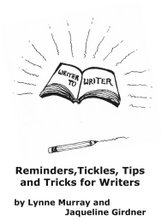
Jaki Girdner and I put together Writer-to-Writer Reminders, Tickles, Tips and Tricks. Between us, we’ve had a total of 22 books published—16 for her, 6 for me. We should know some things worth sharing. The tips take place as a dialog between two writers: Ms. Reminder, who is extraordinarily organized, with tickle files for events planned years in advance, and Ms. Amnesia….well, she has a little problem with authority, outlines and planning ahead. We had a good time writing 52 tips, one a week for a year and an extra one to finish.
With a little help from a graphically sophisticated friend, this was translated into an Adobe PDF, and officially put out as an ebook.
As Hamlet says, "the rest is silence." Silent meditation? Actually last weekend it was silent medication because my back went out the minute the book was all Eeee-ed up, and introduced to Paypal.
Coincidence? I think not.
Of course any novelist is capable of functioning with zero feedback and encouragement. It goes with the territory. Most of the fiction being published even by large presses as such a minimal promotion budget that authors learn quickly to use any publicity idea they can manage to get the word out about their books. Like many authors, I’ve become obsessed with this subject. Not particularly expert, just obsessed.
But how to promote an ebook? Bookstores wouldn't be involved. Hmmm. Repeated internet searches yielded predatory websites that had more in common with “work at home” and multi-level marketing scams than they did with anything remotely applicable to promotion of entertaining material that someone might want to read.
Obviously never telling anyone about the book isn't going to work either.
So, now that my back is better, mentioning Writer-to-Writer Reminders on this blog is the next baby step into the Mountains of E-Madness. You can probably tell I've been re-reading H.P. Lovecraft--but that was this past week--30 years ago I was hitting the library like a locust infestation.
May 4 to May 20, 1977 I read, in whole or in part:
SnowBlind, A Brief Career in the Cocaine Trade, Robert Sabhag
The Fight, Norman Mailer
The Omnivorous Ape, Lyall Watson
The Sound of Two Hands Clapping, Essays by Kenneth Tynan
Sigh, theatrical criticism, Olivier playing all the great classic roles in the 1940's and 50's, I have a weakness for theatrical critical essays, and Tynan was such a superb writer.
Three Tales, Paul Bowles
Note: Esoteric almost to the point of nonexistence
Tiny Tim: An Unauthorized Biography, Harry Stein
Tiny Tim
Intent on Laughter, John Bailey
Couldn’t find much on this, out of print. But when I looked for it, I found and loved, this website.
About Those Roses, Frank D. Gilroy
A Burnt Out Case, Graham Greene
For me the anticipation of reading Greene is always more fun than the actual reading. He just can't seem to make me savor his world-weary depression.
Ya gotta grant him the prize for angst, though.
How the Comedy Writers Create Laughter, Larry Wilde
Turns out this guy is still around, and he invented National Humor Month (April, I missed it, who knew?) I like his good-humored web site.
The Plays of Ferenc Molnar (1929, intro only)
I still have the quote I got from Molnar, slightly paraphrased, on the wall above my writing desk: “Shakespeare was a genius. The rest of us must simply strive to be honest.”
Translation, Stephen Marlowe
Note: very disturbing cover art. Poorly written story
May 4 to May 20, 2007 I read:
The Orchid Thief,Susan Orlean
I also watched the film Adaptation wherein screenwriter suffers so much turning The Orchid Thief into a script, that he takes that struggle as the film's subject matter. Reading the book after watching the film, I could see his problem. The book was essentially a magazine article on intercut with lots of background and information. Interesting but not essentially a story. The movie also had one of my favorite writing teachers, Robert McKee, teaching his seminar on Story. Very cool.
Blood Bound, (Mercy Thompson Series, Book 2): Books: Patricia Briggs
Moving slowly back into the tamer paranormal novels I like so much
At the Mountains of Madness, H.P. Lovecraft
An old favorite, a paperback that must be nearly 40 years old. I’ll talk about obscene vegetation another time.
Friday, May 04, 2007
Secret teachings, the power of positive denial
I slowly eased reading books that are not by Jane Austen (my comfort reads for the past few months!) with a transitional period listening to 4-hour(!) audio DVD of The Secret, which a friend lent me.
The hook that gets people “into the tent” for this product, whether in video, book, or audio, is the pitch that this is a life-transforming "Secret." Yet the underlying principles, whether called The Laws of Attraction, the Power of Positive Thinking are familiar to even the most casual student of self-help books.
I like positive thinkers and New Age presentation people. As Douglas Adams said of the planet earth, they are “mostly harmless” and occasionally helpful. But the kindest thing I can say of The Secret is that it is partial—as in a fragmentary or limited. In its truncated fashion, it explains how, with single-minded thought, a person can affect his or her environment. There are some useful ideas in The Secret, presented with the maximum of smoke and sizzle and very little insight or responsibility.
I will consider using any mental or physical tool that doesn’t clash with my Buddhist practice. (I won’t channel, don’t ask me.) So I’ve encountered (and enjoyed studying) some of these New Age Usual Suspects. I didn’t like the metaphor of ordering your reality from a catalog. That one was too aggressively shallow for me. Also as a world view, the idea that you create the entire universe with your thoughts strikes me as childish at best and delusional at its worst.
I do like the metaphor of “change the frequency of your thought vibrations, like changing the radio channel.” I can almost hear an echo of an explanation of Buddhism as it was presented to Americans in the 1960s and ‘70’s (and it may have been a direct steal—such metaphors do get around). One of the unlooked for side-effects of a Buddhist practice is learning how to become aware of and move out of negative life conditions (as an exercise that must be repeated by the way, it’s not a one-time thing!)
The latter half of the DVD set made me a bit queasy with its exhortations to “believe” when doubt attacks. That sort of talk always induces deep mistrust in me--and an urge to head for the nearest Exit sign.
I’m not going to get into the “negative thinking caused the Holocaust” thread (my brother hit the nail on head when he said, “So, the Holocaust victims were all thinking negatively and the Nazis were thinking really positively?”) This is not the first time such views have been brought forth, but that doesn't make them less offensive.
For me it’s a sure-fire indicator of a con game when the salesperson plays the weight loss card. The weight loss issue draws con men like an overripe banana draws fruit flies. it's such a gold mine that few can resist. Such a large percentage of Americans are freaked out about their weight that playing on the hopes of a magical solution causes many to instantly reach for their wallets.
As a fat person, listening to their spiel, I was pleased at the suggestion not to dwell on your body’s flaws, that’s always more constructive. But I was wryly amused to hear the suggestion that followers "achieve their perfect weight" ("losing” is one of those banned, negative words)by looking away when fat people appear and instead envisioning their internal perfect body. I guess if I walk down the street and see people bumping into lampposts rather than look at me, “la, la, la, you don’t exiiiiiist…la, la, la, I’m thinking of my own perfect body…” I’ll know that it’s a Secretarian. Or will I?
Actually, invisibility in social situations is one of the side effects of getting old and/or fat. All of which The Secret assures me do not have to happen.
When I first started listening to the DVDs I wondered if there was any correlation at all between actual secret teachings in mystical tradition, and the positive thinking stuff they are invoking as the secret of the ages. A friend who is into the Western alchemical/metaphysical tradition pointed out that the concept of secret teachings can be to protect a student from getting in too deep too soon. My own experience in Buddhism has been that even when a secret teaching is revealed it is usually so simple that an untrained mind can’t see any profound meaning at all there. It can take decades of practice to realize how deep something so simple can be.
I suggested to a friend who was about to listen to the DVDs is “take what you need and leave the rest.”
April 16 to May 3, 1977 I read:
1876, Gore Vidal
English Humour, J.B. Priestly
Note: v. fine, also beautifully illustrated. (didn’t finish though)
Stop the Presses, I Want to Get Off, [MORE Magazine] R. Pollak [Ed]
The Man with the Candy, the Story of the Houston Mass Murders, J. Olsen
Read most of it
The American Tradition, A Gallery of Rogues, John Greenaway
Patchwork Mouse, Joseph Hixson
Darker Than Amber, John D. MacDonald
Gateway, Frederick Pohl
Scoundrel Time, Lillian Hellman
I first encountered Hellman in her preface to some of Dashiell Hammett’s posthumously published work. She was a glamorous figure, not the least because of her life with the magnetic Hammett. Who wouldn’t want to be with Hammett? Many were called and briefly chosen, but Hellman was the one who lasted. The fact that he told her she was the model for Nora, of Nick and Nora in The Thin Man made her even more interesting. Nick and Nora Charles have always been the ideal fun couple for more than one generation. Early in their marriage my parents named their dog Asta in honor of the Charles’ memorable terrier. I’ve read all of Hammett several times, but never have read any of Hellman’s non-memoir work, although I did see the movie The Little Foxes, and was startled by how over-the-top melodramatic it was.
From April 16 to May 3, 2007
Aside from listening to The Secret DVD, in the past few weeks I re-read:
Scoundrel Time, Lillian Hellman.
I remember noting what a thin book it was when I first read it, sitting on a bench at a bus stop in 1977. The edition I read recently has it collected along with Hellman’s other memoirs, An Unfinished Woman and Pentimento. Scoundrel Time only takes up 123 pages—with wide margins.
Hellman
I think nowadays Hellman would be called “high maintenance.” She savors and shares her emotions the way some people share fine cuisine. This is part of her charm, and yet one can’t help but mistrust it.
One of the anecdotes she tells is of an old friend, unsuccessful Progressive candidate for President, Henry Wallace, who presented her with a large bag of manure on the occasion of her selling her farm due to financial disaster after she and Hammett were blacklisted and unable to find work. Hellman mildly complains that this was not a gift she could use in the New York apartment she was moving to, and puts it down to Wallace’s total cluelessness—and she gives several other persuasive examples of this. But something about the gift made me wonder if there weren’t others who might have wished to give her such a gift, but just didn’t have it handy when the occasion presented itself.
Saturday, April 14, 2007
A debt to pleasure...of the literary kind
Another almost-month with no books read. Existential anxiety has that effect on me. However, I have been revisiting a manuscript of my own that needs work. That process reminds me why I have always traded financial security for time. (In the interests of full disclosure I should say that every job I've done that offered financial security has been so excruciatingly dull that my mind might have snapped under the strain. So the psychiatrist's bills I have saved by pursuing the muse should be factored into the equation.)
A phrase that keeps coming back to me recently is the title of a book Bruce Taylor set up by the cash register in his Mystery Bookstore in SF, now ably commanded by Diane Kudisch as Bruce has retired. The book Bruce was handselling was John Lanchester’s excellent crime novel, The Debt to Pleasure
Lanchester plucked the quote from John Wilmot, the Earl of Rochester. I'd never heard of Wilmot, which is not surprising, considering how outrageous his work was. I'm not a scholarly student of his time period, and if Henry Miller and D.H. Lawrence couldn't be published during most of the 20th century due to censorship, Wilmot wasn't going to be showing up in any poetry anthologies. He was notorious, even among his fellow Restoration Rakes.
“Hazlitt judged that 'his verses cut and sparkle like diamonds', while 'his contempt for everything that others respect almost amounts to sublimity'.”
Rochester's bio.
Most of his poems seem to include all the commoner Anglo-Saxon four-letter words. His subject matter is either ruttish or scurrilous and the phrase that stuck in my mind from his poem, The Imperfect Enjoyment, is used during a discussion of premature ejaculation—
When, with a thousand kisses wandering o'er
My panting bosom, "Is there then no more?"
She cries. "All this to love and rapture's due
Must we not pay a debt to pleasure too?"
Note, this site is not for the prudish.
The debt Wilmot refers to is the pretty simple, "you pleased me and now I'm incapable of pleasing you, sorry about that, dear." Wilmot died at 33, probably of syphillis--another debt to pleasure paid.
But for me the phrase seems to refer to the cost of doing what you want to do...or need to do.
The book I began to write in the spring of '77 was a good learning experience, but essentially, unreadably bad. Even the title is too embarrassing to quote. I am hoping the friends upon whom I inflicted this book have mercifully forgotten it.
The manuscript I’m now editing is my 10th book. Book 11 is with my agent. Book 12 is in progress, put it aside to do this edit. Although it hasn’t found a publisher yet (and I am finding things to improve in the ms.) Book 10 after lo these many re-writes/re-reads still makes me laugh. It ain’t Shakespeare, but I knew that going in. There are no cringe-worthy moments.
(If you're mathematically inclined, I'll explain that 6 of my books have been published, and 3 sit in the closet, including the abysmal first novel.)
So that’s what I did with my last 30 years. I’m not naïve enough to think that this entitles me to anything in a material sense. But it’s what I wanted to do with my life.
Damn that existential anxiety! I think it’s insinuating a whiny note into this blog. So enough about now, looking back 30 years--
March 11 to April 15, 1977 I read.
Orbit 18, Damon Knight
Victorian Murderesses, Mary S. Hartman
Only got three-quarter way through it.
Carrie, Stephen King
This was one of those books I remember reading, where I was when I read it (on a cockroach-menaced sofa bed, in the dim light of afternoon, at a time when absorbing storytelling was welcome). Whatever one may think of Stephen King after the crushing juggernaut of his success has swept its way through the reading world, I think back to reading Carrie and thinking—wow, that’s good.
A Plague of Demons, John Creasy, as Gordon Ash
The Art of Seeing, Aldous Huxley
Had to skip last few pages.
So You Have Glaucoma, Viers
Note—I didn’t. But the Lions’ free glaucoma testing van student doctors thought I might, and that netted me an anxious few weeks—during which I read this book. Also a free appointment for more extensive testing that indicated I just had weirdly shaped eye nerves…I was the only person under 50 in the waiting room. Also the experience of having my father reassure me that if I did have glaucoma, he would personally drive me to Mexico to get marijuana if I also needed that—my father’s version of worrying, although he was by nature more of a warrior than a worrier.
The Medically Based No-Nonsense Beauty Book, Deborah Chase
Oy. I was 27, living in LA and far from immune to the beauty obsession. I do give myself points for a little common sense with this one.
Magic, William Goodman
Born on the Fourth of July, Ron Kovic
My memory was that I had reviewed this book several months earlier for the Buddhist newspaper. Maybe I was re-reading, as it was quite a powerful book
1876, Gore Vidal
From March 11 to April 14, 2007
Reading and re-writing one of my own manuscripts.
Sunday, March 11, 2007
Jane Austen, hell, heaven, and perfume
I won’t go into exhaustive detail about why, but I’ve had enough of a disruptive month that I’ve been communing with Jane Austen (and a little with Virginia Woolf) these past few weeks. I don’t do images much—but I’ll share with you an image that paradoxically helped me stay sane.
Money and the lack thereof are an issue Virginia Woolf dissects so brilliantly in A Room of One’s Own.
Jane Austen also considers women’s issues around money in all her works, as she said in an 1816 letter: “Single women have a dreadful propensity for being poor. Which is one very strong argument in favor of matrimony.”
While coping with my own employment drama the past few weeks, I found it useful to think of some of the things Virginia Woolf did to support herself before she received the famous liberating inheritance that she wrote about in the aforementioned book.
"I earned a few pounds by addressing envelopes, reading to old ladies, making artificial flowers.” A Room of One’s Own by Virginia Woolf
I must report that for the old and broken among us, the employment opportunities are somewhat, although not vastly, improved since she wrote those words in 1928. I seem to have found a momentary harbor, so I am now calm enough to write this blog.
But to get back some of my strategies for staying sane while losing sleep over survival issues. I read (and re-read) only three books. (Contrasting with 14 books I picked up in 1977 in the same space of time, with an even shakier personal life, but coasting on youthful vitality!) I also visited ther DVDs of Pride and Prejudice and Persuasion, um, more than once.
Why were these so uniquely comforting? Of course, there is sex—or should we say the heartfelt portrayal of youthful passion.
The Republic of Pemberley website provides the graphic I referred to in the first paragraph. It's the last item of their FAQ:
What is "The Look"?
Get ready.
Here.
I was surprised to find that it was the same image that caught my attention. Why should I be surprised? It’s the Bluestocking version of the money shot. But it’s a bit more than that.
The actor and filmmaker’s recreation of the intoxication of young love is like a distillation of the scent of flowers. Spring has gone, but an artfully created perfume stirs a chord that resurrects spring flowers in the heart and mind.
Jane Austen’s books go one better. She re-creates on the page, not only the pleasure of intimacy achieved, but also the satisfaction of integrity rewarded.
That’s the paradox of art. Jane Austen didn’t have that ideal partnership in her life. She never married and died at age 38. I can only speak for myself in saying that at 58 I would contemplate with dismay the vast drain of time and energy that a fulfilling partnership would entail. Of course, a happy ending is just a snapshot in a long story.
Young love pierces our souls (as Frederick says of Anne's words in Persuasion) because it depends on the exquisite sensitivity of innocence, inexperience, ignorance, call it what you will. That naiveté has a season and it does not come again, Botox notwithstanding.
Robert Frost put it well:
Love at the lips was touch
As sweet as I could bear;
And once that seemed too much;
I lived on air
That crossed me from sweet things,
The flow of- was it musk
From hidden grapevine springs
Down hill at dusk?
. . . .
Now no joy but lacks salt
That is not dashed with pain
And weariness and fault;
I crave the stain
Of tears, the aftermark
Of almost too much love,
The sweet of bitter bark
And burning clove.
To Earthward by Robert Frost From “New Hampshire” 1923.
Well, Frost did seem to have a little S&M thing going there that’s only marginally relevant to what I’m mainly talking about, but never mind. He’s right about how complex things become, and how it catches our breath to remember how simple they once seemed—and perhaps were.
From February 8 to March 11, 1977 I read:
Thirty years ago I had just moved twice in the space of a few months (down to Los Angeles from San Francisco. Then out of the Culver City garage apartment I first landed in, to a more serene studio apartment in West LA where the cockroaches came as single scouts--not in battalions), and was sailing on a questionable sea of temp work. Yet I managed to read or attempt 14 books.
Midnight Baby, Dory Previn
The Psycho Sqaud, William W. Crain
The Romeo Error: A matter of Life and Death, Lyall Watson
Note: couldn’t finish in time – had to return to library. Will try again. (note—so far haven’t, but then it HAS only been 30 years)
The 9th Annual Best SF: 75, Harry Harrison & Brian W. Aldiss, Ed.
The Art of Alfred Hitchcock, Donal Spoto
Note: AH is a Leo- Aug 13! Very fascinating book. I also guessed correctly by the author’s use of the adjective “tenebrous” that he was French.
Tricks and Treats: an anthology of Mystery Stories by the Mystery Writers of America,
Joe Gores and Bill Pronzini, Ed.
Something’s There, Dan Greenberg
The Voices of the Guns, Vin McLellen and Paul Avery
The Aliens, Ed. R. Silverberg
Tetrosomy Two, Oscar Rossiter
The Choirboys, Joseph Wambaugh
The Documents in the Case, Dorothy L. Sayers and Robert Eustace
Journey, Robert and Suzanne Massie
Very painful to read, medical students’ disease-I vaguely remember that this book was about a couple coping with spinal cord injury, but I could be wrong.
The Blue Knight, Joseph Wambaugh
From February 8 to March 11, 2007 I read:
Pride and Prejudice, Jane Austen
With some attention to the excellent introduction Penguin Classics edition by Tony Tanner that among other things, speaks to the idea of “the dream of Pemberley” that so many women have mentally inhabited since Austen built the place.
A Room of One’s Own, Virginia Woolf
Persuasion, Jane Austen
Wednesday, February 07, 2007
Old wine, new bottles
The internet came to my rescue once again last week, when I couldn’t locate my paperback copy of Jane Eyre during a week when I was indulging in the stunning BBC dramatization of that work. The BBC site is very cool by the way, Grace Poole's diary was surprisingly touching! But to return to my rescue by the internet--a few days later, while delving into the 1996 (6-hour!) DVD of Pride and Prejudice, I couldn't find that paperback either!
Most classic texts are now available online, so I didn’t have to wait for the delivery of the new copies (or haul out my very heavy Complete Novels of Jane Austen hardcover) to check out how the dramatizations might have changed the sacred texts that have provided emotional healing for me (as for so many others) at various times in my life when it was most needed.
But even the best dramatizations--often the best!--take certain liberties with the text. For example, Jane Eyre’s parting with Rochester after his secret was revealed. I was able to confirm what I kind of remembered from my reading--that no bed was involved in their parting scene in the book (though there was a sofa, it was more used for sobbing than for touching). The breathless chemistry was appropriate to the novel though.
A friend lent me the A&E Pride and Prejudice dramatization, and in return I lent her the 1986 BBC Northanger Abbey, confidently assuring her that Colin Firth was practically a chameleon to be able to play Mr. Darcy in P&P and also play Henry Tilney in Northanger Abbey, and look so different. Almost like a different person.
Astute readers and BBC aficionados will be way ahead of me here. Colin Firth was so amazingly different-looking in his characterization of Henry Tilney in Northanger Abbey because the part was, in fact, played by Peter Firth—another actor entirely. Also excellent--with his own gift for revealing thoughts as well as emotions on screen--just not the same person.
I guess there’s no point in having so many Gracie Allen moments if you can’t laugh at yourself in the process.
At least I discovered that Henry Tilney has his own fan club, who refer to him as "Da Man"--who knew?
My Jane Austen obsession flares often enough that one friend gave me a
Jane Austen Action Figure for a Christmas gift.
I visited The Republic of Pemberley
for the online texts of Pride and Prejudice, and found that Austen summarized, rather than exactly quoting, a great deal of Mr. Darcy’s original, ardent proposal to Elizabeth Bennet, and the A&E dramatization did quite well putting the summary into dialog.
The Republic of Pemberley, by the way, has the subject of each chapter in the link(and a lot of other links to topics in the books).
John Barrymore was of the opinion that stopping to read footnotes while enjoying great works of literature is like answering the doorbell on your honeymoon. I tend to agree. But once you’ve had the enjoyment of a read or two or twelve of some of these books, an appropriate footnote can help deepen the experience. Marital aids, perhaps?
January 21 to February 7, 1977
I can’t help but notice my restless library roving in 1977 brought me home 13 books (some I only partly read, versus the two books, I own but ended up reading online during the same days of 2007).
The Mote in God’s Eye, Niven & Pournell
I enjoyed this book a great deal and have re-read it more than once.
A 30-year-old review goes into the “Crazy Eddie” concept at some length
The Jacqueline Susann Story, Jeffrey Ventura
My note: “effeminate prose” whatever that means.
We’re Going to Make You a Star, Sally Quinn
My note: “a little celebrity watching in the haute monde of the journalism world. Having been fascinated by the Washington Post’s role in investigating Watergate, I read quite a few behind-the-scenes books. My final note was: “The ‘society’ orientation makes me bristle a bit.”Sally Quinn on wikipedia
Lonely in America, Suzanne Gordon,
My note: didn’t finish
Memoirs, Tennessee Williams
My note: Such frankness that one is forced to applaud, yet not particularly painful to read
The Life of Raymond Chandler, Frank McShane
My note: Read some of it. Very sad, dreary
I think that one was really painful to read, although I totally admire his prose, his life was less exuberant and more agonizing than Williams' life.
The Deep, Peter Benchley
My note –Skimpy & trivial but readable. All the villains are black, all the heroes white, coincidence no doubt
Headache: Understanding—Alleviation, James W. Lance
My note: Not helpful
On the Edge, James Mills
My note: Skimpy
Bubbles: a Self-Portrait, Beverly Sills
Future Corruption, Ed. Roger Elwood
My note: very amateurish. Didn’t finish
Combat SF, Gordon R. Dickson
My note: Didn’t even half finish
Singin’ and Swingin’ and Gettin’ Merry Like Christmas, Maya Angelou
No note on this, but I read every Maya Angelou book I could find, poetry and prose.
January 21 to February 7, 2007
I probably enjoyed re-reading these two books as much as I enjoyed reading the 13 from 1977.
Jane Eyre, Charlotte Bronte
Pride and Prejudice, Jane Austen
Saturday, January 20, 2007
Hermits, sociable writers and the quest for myth
For me 1977 was the year that my writing began to take the form of a novel. Writing is such a personal and private thing for me that it's taken me years to understand that some people write well in groups (as it was for Anne Beatts below). That kind of writing still seems to me to be more akin to music than words, but I could see how it would work well for comedy as a performing art, which has a particularly strong rhythmical component.
January 3 to 20, 2007
Titters : The first collection of humor by women, Deanne Stillman and Anne P. Beatts
It’s been awhile since I read this. I didn't quite get at the time just how difficult it was for women to be taken seriously in humor...does that make sense? I mean that there were a lot more male humorists being published than women.
Beatts has famously written about the early Saturday Night Live as not welcoming women:
"The only entrée to that boys club was basically by fucking somebody in the club," Anne Beatts tells Shales and Miller. "Which wasn't the reason you were fucking them necessarily. I mean, you didn't go "Oh, I want to get into this, I think I'll have to have sex with this person.' It was just that if you were drawn to funny people who were doing interesting things, then the only real way to get to do those things yourself was to make that connection."
Here's that quote
This book has been called dated, but I don't have the copy I bought, so I can't check it. I still remember selling my copy at a garage sale. It was the first thing to go—snapped up immediately at a premium price. Maybe the cover…?
Here's what Beatts is doing now.
Intermission, Anne Baxter
This was a fascinating book, one I’ve read more than once—the story of Baxter’s leaving Hollywood for love and a life on a remote cattle station in Australia
Anne Baxter
Homage to Daniel Shays, Collected essays, Gore Vidal
This page gives an idea of the scope of Vidal's life and accomplishment, and ideas that shine in his essays.
Vidal
Early del Rey, Lester del Rey
Here's an interesting 1968 review of 2001 by del Rey
Review
Wampeters, Foma & Grandfaloons, Kurt Vonnegut, Jr.
My comment was “bravo!”
Vonnegut Quotes
January 3 to 20, 2007
Lately I've been retreating even further from the sociable model. The Middle Earth book below gave me some insights into why. I think it's a cyclical thing for me. I remember (like so many people) reading Tolkien as a refuge at 14, and again at 24. After an intermission of decades, I'm back seeking fantasy wherever I can find it.
Crazy in Alabama, Mark Childress
This was unexpectedly fun and funny (I understand there was a movie, and reading the book I can imagine that). The narration alternates between the parallel stories of 12-year-old orphan Peejoe Bullis in a small Alabama town in 1965, and his Aunt Lucille, who has parked her six children with her mother and is bound for Hollywood accompanied only by her murdered husband’s head in Tupperware container.
The Publisher’s Weekly review suggests that the author manages to inject: “magic in his mixture of humor and pathos, boyish candor and time-earned understanding. The narrative has a unique gentleness that tempers even the most extreme horrific or comic events without dismissing or oversimplifying them. Terrible crimes go unpunished, and good people face tragedy--not always nobly--but this remains a tale of laughter and great hope, one not easily forgotten.”
That’s a pretty accurate assessment of an extraordinary narrative accomplishment.
Thunderbird Falls, CE Murphy
The second book featuring Joanne Walker, Seattle beat cop and apprentice shaman. Not as fast-moving as the first book Urban Shaman, but still worth the read.
Meditations on Middle Earth, Karen Haber (Ed)
This book has some great contributors like Terry Pratchett, Poul Andersen, and Robin Hobb
The essays in this book gave me some insight into my own reading tastes lately—
Lisa Goldstein’s essay put it:
“Why do people read and reread these books? Why are they so powerful? What do we get from them that we can’t get anywhere else? ...
“My guess is that it’s because we need myth. Not just because myths are entertaining stories, or because some of them come attached with a moral. We need them, the way we need vitamins or sunlight.
...
We need them because they are magnificent stories, of course, tales that have been told as long as people have existed. But we also need them because they are stories about the hero who journeys into a dark place and comes out transformed, and that is a story we allknow intimately, a story each of us experiences in his or her life. Those dragons are our dragons, those magical helpers are our helpers. And sometimes the dragons are inside us, a part of us, and this is the most terrifying struggle of all.”
January 3 to 20, 2007
Titters : The first collection of humor by women, Deanne Stillman and Anne P. Beatts
It’s been awhile since I read this. I didn't quite get at the time just how difficult it was for women to be taken seriously in humor...does that make sense? I mean that there were a lot more male humorists being published than women.
Beatts has famously written about the early Saturday Night Live as not welcoming women:
"The only entrée to that boys club was basically by fucking somebody in the club," Anne Beatts tells Shales and Miller. "Which wasn't the reason you were fucking them necessarily. I mean, you didn't go "Oh, I want to get into this, I think I'll have to have sex with this person.' It was just that if you were drawn to funny people who were doing interesting things, then the only real way to get to do those things yourself was to make that connection."
Here's that quote
This book has been called dated, but I don't have the copy I bought, so I can't check it. I still remember selling my copy at a garage sale. It was the first thing to go—snapped up immediately at a premium price. Maybe the cover…?
Here's what Beatts is doing now.
Intermission, Anne Baxter
This was a fascinating book, one I’ve read more than once—the story of Baxter’s leaving Hollywood for love and a life on a remote cattle station in Australia
Anne Baxter
Homage to Daniel Shays, Collected essays, Gore Vidal
This page gives an idea of the scope of Vidal's life and accomplishment, and ideas that shine in his essays.
Vidal
Early del Rey, Lester del Rey
Here's an interesting 1968 review of 2001 by del Rey
Review
Wampeters, Foma & Grandfaloons, Kurt Vonnegut, Jr.
My comment was “bravo!”
Vonnegut Quotes
January 3 to 20, 2007
Lately I've been retreating even further from the sociable model. The Middle Earth book below gave me some insights into why. I think it's a cyclical thing for me. I remember (like so many people) reading Tolkien as a refuge at 14, and again at 24. After an intermission of decades, I'm back seeking fantasy wherever I can find it.
Crazy in Alabama, Mark Childress
This was unexpectedly fun and funny (I understand there was a movie, and reading the book I can imagine that). The narration alternates between the parallel stories of 12-year-old orphan Peejoe Bullis in a small Alabama town in 1965, and his Aunt Lucille, who has parked her six children with her mother and is bound for Hollywood accompanied only by her murdered husband’s head in Tupperware container.
The Publisher’s Weekly review suggests that the author manages to inject: “magic in his mixture of humor and pathos, boyish candor and time-earned understanding. The narrative has a unique gentleness that tempers even the most extreme horrific or comic events without dismissing or oversimplifying them. Terrible crimes go unpunished, and good people face tragedy--not always nobly--but this remains a tale of laughter and great hope, one not easily forgotten.”
That’s a pretty accurate assessment of an extraordinary narrative accomplishment.
Thunderbird Falls, CE Murphy
The second book featuring Joanne Walker, Seattle beat cop and apprentice shaman. Not as fast-moving as the first book Urban Shaman, but still worth the read.
Meditations on Middle Earth, Karen Haber (Ed)
This book has some great contributors like Terry Pratchett, Poul Andersen, and Robin Hobb
The essays in this book gave me some insight into my own reading tastes lately—
Lisa Goldstein’s essay put it:
“Why do people read and reread these books? Why are they so powerful? What do we get from them that we can’t get anywhere else? ...
“My guess is that it’s because we need myth. Not just because myths are entertaining stories, or because some of them come attached with a moral. We need them, the way we need vitamins or sunlight.
...
We need them because they are magnificent stories, of course, tales that have been told as long as people have existed. But we also need them because they are stories about the hero who journeys into a dark place and comes out transformed, and that is a story we allknow intimately, a story each of us experiences in his or her life. Those dragons are our dragons, those magical helpers are our helpers. And sometimes the dragons are inside us, a part of us, and this is the most terrifying struggle of all.”
Tuesday, January 02, 2007
Resolute words
Happy New Year to All!
People really do ask what your resolutions are. I don't much like the term "resolutions." I have goals, but they are intensely personal and I think of them all through the year, although a little more on New Year's Day. One thing that brings extra pain to this process of sharing resolutions for the next year is when I run into people who are throwing themselves into the not-so-harmless idea of solving all their problems by losing weight. (Few people call it a diet any more, but most of the resolutions involve restricted eating, and those who get to hear about them often have to suffer through hearing sample menus. Then there's the unavoidable postscript about how unhappy they are with their bodies and how the new "eating plan" will solve all that.)
Lara Frater at Fat Chicks Rule talks about how difficult it is not to resist the fantasy world when everyone around you is buying in big time to the madness and deprivation, and pressuring you to do likewise.
Lara quotes Marilyn Wann’s response last summer to a woman drowning in an ocean of Weight Watchers fanatics swimming in the high tide of "shrink-yourself-to-fit-the-bathing suit" season:
I totally appreciate the constant, pervasive pressure to buy the hate. This is the second-biggest time of year for people to go crazy hoping to be thin. There's January 1 and then there's bathing-suit season. So it's not about you. Fat hatred is just at high tide.
Diets are hate rituals. Any practice that involves a goal of weight loss is a hate ritual. I don't care whether it's "sensible" or extreme. I don't care whether Weight Watchers advises exactly the same food that I choose for myself because it's tasty and nutritious on any given day. They are selling hate. I won't give them a dollar or a minute of attention. As an ethical person, I could never advise another human being to undertake such dangerous, harmful, deceitful scams.
Marilyn's article is in the Summer 2006 NAAFA newsletter.
We now return you to our regularly scheduled reading “retro” book action.
December 24, 1976 to January 2, 1977
The Final Days, Carl Bernstein and Bob Woodward
There's even been a book written about how Woodward and Bernstein's spectacular early success overshadowed later life... Woodward and Bernstein book page.
Ah, well, as they say in the Midwest, thank heaven for small favors. Being a late-blooming, non-spectacular achiever has at least rescued this writer from THAT trauma.
The Once and Future King, T.H. White
This was the second or third time I read this book, which I discovered when I was 14. It was one of those books where you remember the first time you picked it up, where you were and what it looked like. A family friend stored some books and games with us and said I could play with any of the games--which I did, a little--and read any of the books. Wow. This one was a much-read hardcover, but I remember being careful with the dust cover. It’s still a book I make sure to have a copy of at all times.
The Wind Chill Factor, Thomas Gifford
Oddly enough all I remember about this book was that at some point the hero was driving through a blizzard in a Lincoln Continental.
The Middle Mist, Mary Renault
This was one of her modern novels. The Charioteer was my favorite of those, but it is her novels set in ancient Greece—The Last of the Wine, etc.--that I remember with most fondness.
The Samurai, George MacBeth
No recollection of this book
December 24, 2006 to January 2, 2007
The Bromeliad Trilogy: Truckers, Diggers, and Wings, Terry Pratchett
This is not a Discworld book, but Pratchett is always entertaining and these three books about 4-inch Nomes looking for a home is charming, suspenseful and oddly heartening. Pratchett’s theme in this book (as in most of his works) is how learning and growing, and how it gets done in ways you never could plan. A good book to start the new year.
Big Fat Lies, Glenn Gaesser, Ph.D.
This book has been reissued (updated by the author) by Gurze Books, which does a tremendous service in keeping available books on body positive issues, eating disorders and size prejudice. As a baby boomer, I was nine when I ran into my first doctor waving a diet sheet and an amphetamine prescription the late 1950s. The one thing that struck me about this book was how every aspect of the anti-fat obsession affected my life as the national hysteria took root.
Big Fat Lies traces the life insurance industry’s meaningless charts (fervently embraced by the American Medical Association in 1951) and the drive to turn weight into the single measure of health, in spite of overwhelming scientific evidence to the contrary.
Saturday, December 23, 2006
Backstage at strips…and with strippers…
I hope everyone is enjoying the holiday--whatever yours might be. I like the Buddhist idea of starting fresh with the new year--paying bills by year-end, pre-spring housecleaning, etc. A Buddhist friend pointed out that you could (and we probably should) start out fresh every day of the year, but being humans we need to be reminded by having a day set out for the purpose. It certainly serves the purpose of allowing me to postpone the whole new start thing till next week when the actual new year arrives.
Nostalgia and holidays seem to go together, but I try to resist it by means of escaping into fiction, and more recently movies on DVDs. Thirty years ago I couldn't have imagined watching all the BBC dramatizations of Jane Austen's novels (advertised as 17 hours of Jane Austen!); now modern technology has made it easier to escape into the the past.
My holiday reading 30 years ago and this year provide some common themes, or maybe just strange bedfellows. "Backstage at the comic strips" in 1976 and backstage at strip clubs in 2006. Then there's the Alan Alda autobiography that includes fond memories of watching from the wings as his father performed in burlesque, singing while showgirls paraded onstage.
I do find it a little amusing that the one "literary" work on this list back in 1976 is the one I never managed to finish reading.
From December 11 to 23, 1976, I read:
Heroes, Joe McGinnis
I've read some of his other books, notably: The Selling of the President 1968 and Blind Faith, but I don't always connect them as being written by the same person…for what that's worth as an insight.Here's an article on him.
Backstage at the Strips, Mort Walker
One of the major motivations to learn to read for me was to be able to read the comic strips, including Mort Walker's Beetle Bailey, in the Sunday newspaper.
How It Was, Mary Hemingway
This 1961 Time Article
is actually a pretty comprehensive appreciation of Hemingway.
Turquoise Lament, John D. MacDonald
The Sentinel, Jeffrey Konvitz
Konvitz co-authored the screenplay as well (too scary for me, though the book wasn't quite so scary).
Gulliver's Travels, Jonathan Swift
My note is "Only got as far as page 67…" Oh, well, maybe one day...
From December 11 to 23, 2006, I read:
Strip City: A Stripper's Farewell Journey Across America, Lily Burana
Backstage at a whole different kind of strip, Lily Burana is taking a final strip odyssey across the US in order to come to terms with a five-year stretch stripping in her teens and twenties before getting married. Burana now lives in Wyoming and writes fiction as well as nonfiction.
Never Have Your Dog Stuffed: And Other Things I've Learned, Alan Alda
Interesting autobiography and insights from Alan Alda, who seems as genial and witty on paper as he is on film and video.
website
Sunday, December 10, 2006
Structural integrity in characters & character integrity in life
November 25 to December 10, 1976 I read:
Caution, Inflammable, Thomas N. Scortia
Short stories.
Thomas N. Scortia
Josh, My Up and Down, In and Out Life, Joshua Logan
What I now remember about this book was Logan's thoughtful discussion of his struggles with manic depression and how it both helped and hurt his art.
an appreciation
However, my note to myself on reading the book was more structural:
Interesting point: Maxwell Anderson's definition of enduring drama--a hero must learn his own fatal flaw and grows in the process.
And--
Logan's def. of farce as desperation of characters over a misunderstanding or problem that is tragic to them, ridiculous to the audience. The characters' mounting desperation captures the attention and makes the farce "move rapidly."
November 25 to December 10, 2006 I read:
Don't Weight: Eat Healthy and Get Moving Now!, Kelly Bliss
I wouldn't have bought this book if I hadn't read Kelly Bliss's website. I was curious to hear the rest of her story. But I'm glad I did. In 1980, long before Jennifer Portnick's discrimination case against Jazzercise, detailed in an interview here, Kelly Bliss was encountering blatant prejudice against instructors, however fit and talented. At 5 feet tall and 127 pounds, she was frankly told that she could not be hired, despite her excellent qualifications, because she did not fit their company image of an extremely thin instructor. The suggestions the interviewer made were identical to the advice Bliss had received years earlier that had sent her into an eating disorder.
She responded first of all by tell the interviewer just what kind of damage she was doing by handing out such advice(go Kelly!), then she went out to start her own classes, offering low impact exercise at a time when it was rarely offered. She made such a success of this business that she was about to start her own studio in 1991, when a traffic accident left her with a seizure disorder and she had to begin again. Just coming back from that kind of injury is impressive, but she gained the wisdom from the experience to reach out to others in new ways. Bliss's accomplishments in mentoring and inspiring others are very healing just to read about. Few people offer such a contagiously positive attitude. Her creative problem solving approaches to fitness for people of all sizes and levels of ability totally charmed me.
Touch the Dark, Karen Chance
This book raised a question for me--at what point do I put down a book that has a fat joke or jokes. Sometimes, as in the case of several of J. K. Rowling's Harry Potter books, I will read the whole book despite long, painful scenes of blatant fat bigotry, simply because the author is an irresistible storyteller. In this case, when the evil master vampire is described as "a soccer ball with legs" I realized that the author was trying to whip up the reader's negative emotions by describing the villain as disgustingly fat. Mission accomplished. Negative emotions whipped up.
I was only on p. 43. Maybe there were other fat jokes, or just the usual horny paranormal critters with flat stomachs. The author did bring out disgust in me, and hadn't hooked me hard enough with her storytelling to keep me reading. So I decided I'd hit a good stopping place and put the book down with no interest in picking it up again.
Anybody Out There?: A Novel, Marian Keyes
I have read most of Marian Keyes books with great pleasure and this was no exception. Part of her skill here is to keep suspense high simply by slowly revealing why and how the heroine sustained her serious physical injuries and what is behind her emotional pain, and then, once that is revealed unfolding how she copes with it.
Dead Man Rising, A Dante Valentine Novel, Lilith Saintcrow
In this second in the series, heroine and Necromance, Dante, doesn't actually go visit hell and accept an assignment from the Prince of Darkness as she did in Working for the Devil, but the plot is equally dramatic. I enjoyed it.
A detailed review.
Friday, November 24, 2006
Triskaidekaphilia
Because both of our parents were from the Midwest, my brother and I heard a lot of G-rated swear words when growing up. One of my favorites my father used was "Triskaidekaphobia" which means fear of the number 13. The wikipedia page on this was fun, because it introduced me to the word friggatriskaidekaphobia, which sounds like something Sylvester The Cat might mutter when really perturbed.
Evidently there is at least one person who loves the number. I'm neutral on the actual number 13, but I really loved the book I read this past week The Thirteenth Tale (see below).
November 12 to 24, 1976 I read:
Bring on the Empty Horses, David Niven
I recall this as a charming and amusing book.
one Niven site.
Change Lobsters and Dance, Lili Palmer
I couldn't find much about Lili Palmer online until I looked for Rex Harrison and Lili Palmer. Being married to Harrison seems to have captured more public attention than her acting, which is generally held to be excellent, though she never became a star of the same magnitude. If this link works, here's a lovely picture of her.
Palmer tells the story that Harrison (then known as "Sexy Rexy" for his philandering ways) asked for a divorce so as to marry Kay Kendall, who was dying--the idea being that he would remarry Palmer afterward. That story sounds like the plot of an old-style "weepy" movie, and it's a little hard to believe. They divorced, Harrison married Kendall, who did die a few years later. Harrison and Palmer did not get back to together. Did anyone really think that would happen? Maybe so. People say and do equally as weird things around relationships and give equally as bizarre explanations every day of the week. In this case all three parties were actors, who dealt spent a great deal of their lives creating illusions. Perhaps they exercised the famous "suspension of disbelief."
Those Who Can, R. S. Wilson, Ed.
No memory of this book.
November 12 to 24, 2006 I read:
Speaking of believing things, sifting truth out from smoke and mirrors, that's a major theme in the book that I liked so much....
The Thirteenth Tale, Diane Setterfield
This book captured very well the hypnotic power of stories--the quote on the back gives its flavor:
My gripe is not with lovers of the truth but with truth herself. What succor, what consolation is there in truth, compared to a story? What good is truth, at midnight, in the dark, when the wind is roaring like a bear in the chimney? What you need are the plump comforts of a story. The soothing, rocking safety of a lie. Vida Winter.
in The Thirteenth Tale
I think it’s something closer kin to dreams rather than lies that stories tell. But part of the art of story telling is in the difference between those two words. "Lies" is a word with a stinging hook in it, while "dreams" is a sweet and sappy word, without enough of a barb in it to snare you in to hear the tale. The quest for the truth among thickets of seductive stories is the theme of this book. The hidden secrets of a reclusive novelist are gradually revealed in the story she needs to tell, but can hardly bring herself to utter. The story needs to be drawn out of her by the narrator, a young woman who has her own ghosts to exorcise in the process. It doesn't get better than this book.
Gil's All Fright Diner, A. Lee Martinez
This book has the dubious distinction of being the first one I've ever posted a negative review about on amazon.com. I got very angry when a book that looked like silly fantasy fun suddenly started dripping authorial venom on one of its characters--a fat woman. The first 14 pages introduced the heroes, Duke and Earl, a grubby werewolf and vampire--seedy vagabonds who wander into Gil's All Night Diner. At that point the author throws in several sneering paragraphs of contemptuous description of the fat woman who owns of the diner.
This woman treats the down-on-their-luck guys very decently, offering them work, food and a place to stay. Then on p, 47 (also known as where I stopped reading), the diner owner tries, in a hesitant way, to seduce the seedy werewolf "hero" who turns away. The author then provides a detailed interior monologue--four pages worth!--of the hero's revulsion at being offered such an unappetizing body, culminating in the werewolf's self-loathing for being the kind of male (one can hardly say "man") who only attracts such a "fat/ugly" women. Let me just say, as I did on Amazon and have elsewhere, that I think telling fat jokes is simply another manifestation of the same prejudice that was reinforced when in-group solidarity was affirmed by telling jokes targeting racial minorities, women, gays and Jews. The assumption was that the targets of these jokes would never be in the audience to hear them. The purpose of the joke was to unite "us" against "them." When it comes to fat jokes in a book, I am the "them" being targeted, and it makes me sick to pay money to be insulted.
I won't comment on the fate of this particular copy of the book, except to say that it won't be spitting venom at any other fat readers--paper can be recycled.
Working for the Devil, Lilith Saintcrow
As if to offset the above disappointment, this author was definitely a happy discovery for me. Dante Valentine, her tough-minded, psychically gifted heroine, raises the dead for a living. This owes a debt to Laurell K. Hamilton, Kim Harrison, etc. It's set in a gritty, Blade-Runner-with-Psychics-Unchained world. A world that has suffered an apocalyptic meltdown of religion and many of its institutions in the face of events that proved undeniable truth of the existence of supernatural entities. The first few scenes take the heroine literally to hell to accept a job to assassinate a demon for the Devil--the alternative being her own death and quite possible the end of human life. Definitely a high stakes game, and a well-told tale.
Saintcrow's cool web site
Sunday, November 12, 2006
Reading Thomas Harris without a helmet and other desperate acts
October 28 to November 12, 1976, I read:
Crime Prevention in the 30th Century, Hans Stefan Santesson, Ed.
Still around.
The Odd Couple, A comedy in Three Acts, Neil Simon
In those days I read a lot of plays. Neil Simon writes funny, even on the printed page.
The Subject Was Roses (A Play in Two Acts) , Frank Gilroy
This play won the Pulitzer Prize.
Marathon Man, William Goldman
Nobody does it better. No matter what "it" you're talking about.This is the book (and later the movie, the script for which Goldman also wrote) that set dentistry back a-ways.
Black Sunday, Thomas Harris
In this, his first novel, Harris demonstrated that he was/is a superb writer. It was his next, even better-written book, Red Dragon, that I wish I hadn't read. Worse yet, Harris is a slow writer, the book was reprinted, and I was half way through a second read before I realized I had been down this road once and I wasn't going to enjoy where it went. I finished it--I didn't say it was bad, just extremely disturbing.
After being traumatized by Red Dragon, I read The Silence of the Lambs some years later only because I was in a kind of death wish state. Others might ride motorcycles with no helmet--I read Thomas Harris, also without a helmet. I'm happy to say I have not got to the point since where I need to read any of Harris's others. At the end of The Silence of the Lambs, I could see that he had fallen for his villain and was revving up for a sequel and I personally was not crazy about making Hannibal the Cannibal the hero of the next book. Did you realize that if he'd named the character Norman, he would have had to be Norman the Mormon. I'm just saying is all…. It would have been a different book that's for sure.
October 28 to November 12, 2006 I read:
Assassin's Apprentice (The Farseer Trilogy, Book 1), Robin Hobb
Speaking of being in a kinder, gentler mood, this was a medieval-style fantasy world, with an apprentice assassin, who had a troubled origin and undeveloped occult powers. It was a page-turner without being bone-chilling. I rarely chill my bones these days unless it's totally inavoidable--just a lifestyle choice.
Robin Hobb's web page
The Other Side of the Story: A Novel, Marian Keyes
This author is one I particularly like, and I'm so persnickety about what I read nowadays that it's hard to predict what I will enjoy. This was a long book--like 600-plus pages, but the characters were all interesting and going through some difficult times, with humor and a satisfying resolution. I did find the various viewpoints a little jarring the first time the author suddenly switched focal characters. But it's the author's voice that makes Keyes books enjoyable to me, so I hung in with her.
Friday, October 27, 2006
Wandering the web...with or without aim
October 22 to 27, 1976 I read:
Mom, the Flag & Apple Pie, ed of Esquire and others, particularly Gore Vidal, Gordon Parks, Marshall Brady, Andy Warhol, Jean Stafford, R. A. Arthur
Murder and Madness, D.T. Lunde
This book turned out to be a frequent re-read when I was writing mysteries some years later
The World of Jimmy Breslin, Jimmy Breslin
Didn’t finish this.
How to Talk to Practically Anybody about Practically Anything, Barbara Walters & friend
Would that it were that easy.
October 22 to 27, 2006, I didn't read any books at all.
I'm overhauling my web page--at long last. When I started talking to my web diva, Sue Trowbridge, about this, she pointed out that I do have a chatty little note in my bio along the lines of, "As I write this in 1998…" Eeek! The cute little tuxedo kitten sucking on my neck as I wrote that, has now grown up to be a compact adult cat, who…well, he's grown up enough to only drool a little and we've worked out a deal where he confines the claw-kneading/drooling to a towel around my neck. Unfortunately, every time I pick up a towel…
Anyway, I've been looking around to see how web pages are done in this millennium…
So I spent way too long trolling through the shallows of the net, looking for what I know not. They say that Truman Capote's last years were spent reading magazines when he coulda, shoulda been writing that unfinished book that offended so many people. I get the impression that alcohol involved in that case.
In this case, no alcohol--just the insidious lure of information. Wandering on the net, you can snare things you never expected, even as large segments of your life slip down a black hole never to be seen again.
I blame the New York Times online or maybe YouTube for the last episode. The NYT story on Weird Al Yankovich provided a link to YouTube's where Yankovich's parody of Star Wars was performed to the tune of American Pie.
As a totally word-obsessed sixties survivor I fixate on song lyrics the way more visual people fixate on album cover art. Weird Al's parody ensured that I woke up the next morning pondering, "Do you recall what was revealed the day the music died?"
Um, no, I don't recall it, because I never figured those lyrics out at all.
The folks at Don McLean's web page didn't seem to have figured them out totally either, but the effort to do so has evidently become a cottage industry, which is probably even better. On his web page I saw a link with something else I hadn't realized. As it says: "Don McLean is immortalized as the subject of the Roberta Flack/The Fugees No. 1 hit, Killing Me Softly With His Song." The link on that page takes us to a page explaining that this song was originally written for Lori Lieberman, inspired by a poem she wrote after watching Don McLean perform. Who knew?
"Who is Lori Lieberman?" you may ask--even as a sixties survivor. I asked. So I searched out her web page and found that she's been living the good life in LA and writing songs all this time, presumably having come to terms with the past
Lieberman has a new CD out and it was endorsed by Christine Lavin, another person I never heard of, but who sounded interesting when I looked her web page. I also loved the wonderful (free download) Stop Your Sobbing wherein the friends of a jilted person do the Happy Dance that she/he has gotten rid of the jerk they have hated for lo these many years. Certainly this song should be provided at a judicious moment to heartbroken people everywhere
song
And furthermore, Lavin has collaborated with many other artists on a CD (with cookbook!) of food songs entitled One Meatball…which just so happens to be the name my father gave my pet alligator, whom I remember fondly in a recent essay. (My father named the alligator that after the Andrews' Sisters hit song by that title, although most folksingers reference the Dave van Ronk version.)
album
This brings me back full circle, so here's where I had to stop.
One Meatball
Christine Lavin
Weird Al Yankovich
Lori Lieberman
Roberta Flack
Killing Me Softly"
Lynne Murray
30 Years Ago Today
Sunday, October 22, 2006
Crates full of genius, dream lives & fictional refuge--once more with links!
--somehow the links didn't come up, I hope they do this time! L
From October 9 to October 21, 1976 I read:
The Rest of the Robots, 8 Stories from Isaac Asimov
This was fun to read, I still remember Robopsychologist Dr. Susan Calvin
wikipedia.
The Clewiston Test, Kate Wilhelm
My note--mucho depressing feminist "attitude" study
The Silent Clowns, Walter Kerr
The Story of a Novel, Thomas Wolfe
this site shows a picture I particularly like of Wolfe standing with his foot propped up on "one of three crates containing the sprawling manuscripts for
Of Time and the River.
Yikes. I read all of Wolfe's books when I was a teenager, and he appealed to my enthusiasm and energy. I don't know if I could re-read him. Maybe. He's pretty much overflowing with lyrical stuff. Of course, he did die at the age of 38, so maybe he had to squeeze it all in.
I had to love the (probably untrue) story of editor Maxwell Perkins informing Wolfe that his book was now complete and getting the reply, "It is?" I probably wouldn't be so fond of that story if I hadn't absorbed the idea that it is somehow "better" to be a genius pouring out great quantities of prodigious manuscript. You write what you write. Legendary editors like Perkins aren't available for most of us poor slobs either. So we have to deal with it the best we can.
Such a Strange Lady, Janet Hitchman
Bio of Dorothy L. Sayers, my recollection is that it seemed like a very sad life--perhaps a motivator to create such a strong dream world in her fiction. this site has a more intimate picture than you usually see of her (though not as carefree as the one of Agatha Christie with her surfboard--I kid you not, there is such a picture!)
Shogun, trying to finish
I had thought I finished this earlier, but I guess I put it down and picked it up again. My note was: 10/17 = finished whew!
October 9 to October 21, 2006 I read:
Reading Lolita in Tehran, Azar Nafisi
This is an interesting book, and an exquisitely written one, as the evocative title suggests. But it's definitely not a fast read. The author is covering 17 years of living and teaching Western literature in her hometown of Tehran, as it slipped into the kind of totalitarianism where the works of Western fiction she was teaching about were viewed as dangerous. Eventually, to satisfy her need for uncensored educational experience, she began teaching a special class in her home for the more motivated female students. I finished the book at a leisurely pace, and was glad to have read it for the evocation of an unknown world as well as the insights on Nabokov, Henry James and Jane Austen as they relate to the condition of women who have been robbed of most of their civil rights due to a fundamentalist religious state.
One thing that made my interest level in the book rise and fall was the way it slipped back and forth in time. I identified enough with the author that I was relieved when she got out of Dodge, as it were, without getting arrested for teaching an illegal class, letting her veil slip or getting caught having a cup of coffee with a male colleague. Just reading about that degree of repression was claustrophobic, and hearing of the sad fate of so many people in the book saddened me. The author's powerful belief in the elevating effect of literature gave it a transcendent quality as well.
this site has an article by Nafisi.
Asimov
Thomas Wolfe
Dorothy L. Sayers
Janet Hitchman
Azar Nafisi
Lynne
Murray
Sunday, October 08, 2006
yarnspinners and fun research
Just a quick update with more links than comments.
October 1 to October 8, 1976
The Man in the High Castle, Phillip K. Dick
a website maintained by the author's family.
The Quick Red Fox, John D. MacDonald
an appropriately nostalgic site
Colette, a Taste for Life, Yvonne Mitchell
The Super Crooks, A Rogue's Gallery of Famous Hustlers, Swindlers and Thieves, R.M. Williams
October 1 to October 8, 2006
Haunted Land: Investigations into Ancient Mysteries and Modern Day Phenomena, Paul Devereaux
This was research for me, to factual to be very juicy, but I found some possibly useful things.
web site
Neverwhere, Neil Gaiman
Rereading a book I first read a few years ago. Just as good the second time.
website
Topper,, Thorne Smith
This was a re-issue with a great foreword by Carolyn See. Definitely humor from a byegone age. Smith's hero has something in common with the Thurber daydreaming guys who live in fear of women. For me, the movie (Cary Grant as a ghost, wow) and the television series with Leo G. Carroll evoke fond memories that the book didn't quite...
one site
also
and a critiquey site.
Sunday, October 01, 2006
still escaping after all these years
[Apologies about the wierd formats. Too late for me to figure out!] L
September 16 to 30, 1976 was a good time for biographies, a mixed bag of nonfiction
and escape into thrillers and political cartoons, I read:
Jack Lemmon, Don Widener
Sylvia Plath, Method and Madness, Edward Butscher
My note: a psycho-critique -naïve in the extreme, lovingly calling Plath "neurotic" and "manic depressive" as if synonyoms for "nervous" and "moody."
Oscar Wilde, Louis Kronenberger
Pumping Iron, Charles Gaines & George Butler
This was a book, not the film, but by the same people
Post-mortem, D.M. Spain, M.D. w/Janet Kale
For Money or Love, Robin Lloyd
I had to look this up to see that it was about homosexual boy prostitution. Not the same boys as the Boys from Brazil below, that was about Nazis coming out of hiding.
The Boys from Brazil, Ira Levin
Gotta love the Stephen King quote in Wikipedia calling Ira Levin "the Swiss watchmaker of suspense novels."
Speaking of Inalienable Rights, Amy, G. B. Trudeau
September 16 to 30, 2006, I took a pretty simple escape route into an alternate world, I read:
A Fistful of Charms, Kim Harrison.
More about Rachel Morgan, the witch and "runner" (essentially a paranormal private investigator in an alternate world where half of humanity has been decimated by genetically engineered "killer tomatoes" and the witches, vampires, werewolves, pixies & etc., & etc. are able to come out of the closet without fear of lynching, and live in an uneasy state of truce.
I love this interesting world Harrison has created, but I see symptoms of a syndrome that affected both Laurell K. Hamilton and Patricia Cornwell's heroines. I don't know how to describe the way the effect is created. It may be worth studying, but the upshot (for me anyway as a reader) seems to be that
(1) Almost everybody (except the bad guys) loves our heroine, who is markedly deficient in common sense on many occasions, but that's just part of her charm.
(2) people who used to be close to our heroine have now turned into "bad guys" and it's not our heroine's fault, she's just too much of a softie to realize that they aren't worth her time and/or they're just jealous of her.
I have no idea where these fictional quirks come from, but they took me out of the story and made me impatient with the characters (which I think was the opposite of the intended effect).
Saturday, September 16, 2006
T'ain't funny, McGee…or is it?
A short essay just posted on my web page was inspired by the recent death of "Crocodile Hunter" Steve Irwin. I started thinking about the alligator in my life--My Pet Alligator. It's a true story. When I do a web page revamp in a month or so, I hope to post more short essays, and make a more prominent place for them.
I've been thinking about what people find funny. One young humor essayist posted a rejection he got from an editor who said essentially "humor is a knee-jerk reaction" and I agree with that. Humor is fragile and ephemeral and can get lost in translation or in time.
Oddly enough, the catch phrase "T'ain't funny, McGee" popped into my head. It's from the 1930s to '50s radio show Fibber McGee and Molly. (Lots more info on a great Wikipedia entry linked below.) I must have heard the radio show in its latter days in the 1950s because the famous closet-contents-pouring-out sound effect is burned into my memory. And it's still funny to me. Maybe because my closet is in a similar state--don't stand too near when you open the door. I love the burglar idea described below!
[N]one of the show's running gags was as memorable or enduring as The Closet---McGee's frequently opening and cacophonous closet, bric-a-brac clattering down and out and, often enough, over McGee's or Molly's heads. "I gotta get that closet cleaned out one of these days" was the usual McGee observation once the racket subsided. . . .
Exactly what tumbled out of McGee's closet each time was never exactly clear (except to the sound-effects man). But what ended the avalanche was always the same: a clear, tiny, household hand bell, and McGee's inevitable postmortem. Naturally, "one of these days" never arrived. A good thing, too, in one famous instance: when burglars tied up McGee, he informed them cannily that the family valuables were in The Closet. Naturally, the burglars took the bait. And, naturally, they were buried in the inevitable avalanche, long enough for the police to come and cuff them and stuff them.
Wikipedia entry.
The entertainment landscape, and the internet in particular are littered with would-be funny stuff, and that adds to the anxiety of those of us who try to write things that make people laugh. We spend a lot of time wondering if we're playing the Main Ballroom in the USS Titanic, while the real action is in the Lifeboat Lounge.
September 10 to 16, 1976, I read:
Hustling, Gail Sheehy
I liked this book, which was an investigative reporter's exploration of prostitution.
When I searched online, I found this quote from the book:
There is no more defiant denial of one man's ability to possess one woman exclusively than the prostitute who refuses to redeemed. (The quotation site where I found this didn't give exact details of book, page number, etc., but I'm guessing it's from Hustling rather than Passages)
If you look at Sheehy's website, you can see that her mega-bestseller Passages kind of put her into the "passages" business, and that word is used somewhere in the description of every one of the books listed on her site. I don't know if I've got Passages on my 1976 books read list--it was published that year, and for a long time I had trouble having a dialog with other women who kept citing chapters of it. I know I tried to read it, and I don't think I got far. I've got nothing against pop psychology but for some reason I couldn't get through that particular book. However, it seemed to have helped a lot of people feel good about themselves, which is good. Hustling isn't mentioned on her website, I personally think it shows diversity, but I guess it might alienate some who would enjoy all her other works.
The Brain Changers, Maya Pines
My note was: shuffled thru, clumsy, rather irritating read
Wasted: The Story of My Son's Drug Addiction, William Chapin
I remember this as a sad but powerful book. I hadn't realized it was nominated for the Pulitzer Prize till I read the link below.
website
Modern Science Fiction, Norman Spinrad, Ed.
Science Fiction today and Tomorrow, Reginald Bretnor, Ed.
September 10 to 16, 2006 I read:
Thief of Time, Terry Pratchett
Thud, Terry Pratchett
Once again a Terry Pratchett orgy is coming to an end when the books run out. I know when I buy more I will be back on the Pratchett express to wherever he decides to go. No frequent flyer miles, alas!
Terry Pratchett
William Chapin
Gail Sheehy
Maya Pines
Fibber McGee and Molly
Steve Irwin
Crocodile
Alligator
Lynne Murray
Sunday, September 10, 2006
Books to escape with and into...
The names change, but reading to escape remains the same. All these books were fun to read.
August 30 to September 9, 1996
In Search of Wonder, Damon Knight
web site
Eaters of the Dead, Michael Crichton
Interesting that Crichton used historical materials from the 10th century explorations.
web site
Norstrillia, Cordwainer Smith
The only novel by Cordwainer Smith, pseudonym of the late Paul Linebarger, a professor and part-time spy, but it portrays the same future world as his amazing short stories.
web site
This was a pretty cool Virtual Reality Tour of the 160th century worlds Smith imagined.
web site
Shogun, James Clavell
Like Chrichton, Clavell wrote about an actual historical situation--a handful of Europeans in isolated 16th century Japan.
web site
August 30 to September 9, 2006
Only You Can Save Mankind (Johnny Maxwell Trilogy, 1.), Terry Pratchett
Johnny and the Dead (Johnny Maxwell Trilogy, 2.), Terry Pratchett
It might be awhile before I get to 3 of this trilogy, because these are very slight books, more like a Terry Pratchett sample compared to one of his full-length books. I probably will eventually read it though, because I'm fairly solidly addicted to Pratchett's work and eventually I'll run out of books to read…it's getting down to the last few already…
Dates From Hell, novelettes Kim Harrison, Lynsay Sands, Kelley Armstrong, Lori Handeland
I hate to say it, but after a few days I remember some of these more than others.
"Undead in the Garden of Good and Evil" by Kim Harrison is a prequel to Harrison's Rachel Morgan series (Dead Witch Walking), in the form of a story of vampire Ivy's point of view. This one I liked and remembered, and felt it added to the "witch" series.
web site
"The Claire Switch Project" by Lynsay Sands. This uses a "molecular destabilizer" plot device, allowing the heroine to morph into different forms simply by looking at a picture. Paradoxically it was way too giddy to be funny to me, and an early scene establishing that most of the lead character do experiments on "bunnies" threw a bucket of ice water on me that chilled the rest of the story so that it was neither funny nor cute to me. (I couldn't quite "get to" the website for Linsay Sands, the URL links didn't work for me, sorry.)
"Chaotic" by Kelly Armstrong was a very strong read for me, introducing Hope, who is half demon, with an ability to see and an appetite for chaos that allows her first to apprehend and then to bond with jewel thief and werewolf, Marsten there are some interesting twists and turns in the story. I'll definitely check out more of Armstrong's books. web site
"Dead Man Dating" by Lori Handeland was enjoyable, featuring Kit Morelli, whose hot date winds up with her nearly dying in an alley at the hands of a demonic life-draining entity. I guess we haven't really all been there, but sometimes it feels like it. Rescued by demon hunter, Chavez, she finds that to save herself she has to get involved in his mission to hunt every kind of monster and demon there is--talk about a workaholic boyfriend.
web site
Tuesday, August 29, 2006
Close encounters of the paranormal kind
For those who are considering buying the new obesity epidemic, I've written an assessment in the form of an owner's manual, now up on my website at The Care and Feeding of Your New Obesity Epidemic.
August 26-29, 1976 I read:
The Reader Over Your Shoulder: A Handbook for Writers of English Prose, Robert Graves, Alan Hodge
I didn't finish this book, which I believe was recommended by Mel Gilden, whose science fiction short story writing class I had just taken. The main point I got from the book was that everybody writes crap--even the great ones, if you sample their work at random, will write garbage. So shut up and write already. Reading some reviews of the hardcover on amazon.com I see that the authors rip up the poor examples of prose from Hemingway, Huxley and Shaw and are very strict with perpetrators of poor syntax. Oops, didn't get that far. I evidently misunderstood the thrust of their argument, but I can't say I regret the message I took away from the part of the book I did read. I also don't regret not finishing it.
Capricorn Games, Robert Silverberg
F&SF July '76, The First Time
(The magazine, The First Time might be a novel or novella…?)
Insanity Inside Out, Kenneth Donaldson
August 26-28, 2006:
I read a so-called paranormal romance novel this week. I didn't know that such a subgenre existed till recently. But almost as soon as I finished the book, I found that Susie Bright had done a fascinating interview it's the August 28, 2006 entry of her web log, the full text of an interview for Publisher's Weekly on the success of the romance genre and its impact as mainstream erotica for women. She also offers some sobering perspectives about the publishing industry
The book I read was:
Night Play (A Dark-Hunter Novel), Sherrilyn Kenyon
Speaking of Publishers Weekly, I can't improve on this description from their review:
Can a gorgeous werewolf with magical powers and an overweight boutique owner with a broken heart have a future together? They can in Kenyon's fantastical world, which imagines a contemporary New Orleans teeming with vampiric Daimons, immortal Dark-Hunters and various were-bears, leopards and wolves. Vane Kattalakis is a lone wolf in every sense. His brother, Fang, is in a coma; his werewolf father wants to kill him; and his mostly human mother, who was taken by force by Vane's father, would happily see them all dead. But after Vane shares a sizzling sexual encounter with Bride McTierney, he realizes his life is about to change. Bride is Vane's "predestined mate," which means that he has three weeks to convince her to be his partner or he'll spend the next several decades impotent and alone.
I wasn't so sure I'd continue, but once I started reading, I spent the day with the book. Can't argue with that. It worked for me as escape. Interesting how commenters on Amazon freaked out over the heroine being a size 18 and feeling no one could love her because of her size.
Sherrilyn Kenyon also writes as Kinley MacGregor and has an interesting web site at
this link
Kinley MacGregor
Sherrilyn Kenyon
Susie Bright
Paranormal romance
Robert Graves
Publishers Weekly
Mel Gilden
Obesity Epidemic
Lynne Murray
Friday, August 25, 2006
A wild buffet (I'd avoid the surrealist casserole...unidentifiable fragments)
August 9 to August 25, 1976 I read:
The Magic Barrel, Bernard Malamud
I had no memory of this book. The author died in 1986. I found this story online that only brought back the faintest whisper of memory, but it's a brilliantly written, evocative story.
Papa, A Personal Memoir, Gregory Hemingway, M.D.
I don't remember much about the book except, obviously, that it was written by the novelist's son.
I wasn't a cat person when I read this book, that came later. But Ernest Hemingway the descendents of some of his cats at the Hemingway House on Key West are embattled. It's a stable, cared-for, neutered group (with the exception of a select few descendants of the Hemingway original 6-toed cats). The cats live at the museum/house and they are threatened.
home website
FYI, if interested: petition website
Space, Jan Faller
My note is: The personal account of a divorce. Tres dreary.
New Dimensions, Robert Silverberg, Ed.
The Doctors Metabolic Diet, Kremer & Kremer
30 years ago I was still on the diet rollercoaster. I went online to see if Kremer & Kremer were still around and still marketing their diet (maybe there was a Kremer v. Kremer lawsuit over the book--sorry couldn't resist). Anyway loads of other profiteers have their own metabolic diets for sale circa 2006, I guess you can't patent that concept, even though it was about as effective as every other diet plan. Is primary goal was enriching the book's authors. In 1976, I didn't get that. And I suffered for not getting it.
I've been separated from the diet wars for so long, that when I searched for the book title, I saw an ad for "the metabolic typing diet" I thought it must have something to do with keyboarding--the carpal tunnel diet, etc.
Comic-Stripped American What Dick Tracy, Blondie, Daddy Warbucks and Charlie Brown Tell Us About Ourselves, Arthur Asa Berger
I looked at some of this author's other books--yikes, semiotics! That's a word that always looked to me like it should be on a label: "warning this product contains semiotics." No, don't ask me to look it up. I've looked it up several times over the decades and my brain rejects it every time--I think I'm allergic. Interesting range of works though: educational murder mysteries, books on Jewish comedy, oceangoing tourism, visiting Vietnam, television. I look further and see him listed as a professor at my alma mater San Francisco State University. Okay, now I'm not surprised. San Francisco State is a place where you can have freedom to experiment wildly. The downside is no one will notice, no matter what you do.
Blue Money, Carolyn See
I liked this book--still remember it--and I'm glad to see that Carolyn See is still alive and
writing
Without Feathers, Woody Allen
Interesting website, about, not by Allen, has a list of all his work.
August 9 to August 24, 2006:
Haven't read so much during the last few weeks. I've been writing more, reading less. That happens, although I can tell I'm about ready to jump into some escape fiction and stay submerged for awhile.
The Essential Kathy Acker, Kathy Acker, Ed & Intro: Amy Scholder, Jeanette Winterson, and Dennis Cooper
The great French writer, Colette, famously said: "Look for a long time at what pleases you, and a longer time at what pains you."
I was warned in the disclaimer that this was experimental, and usually I don't take well to being an author's lab rat, but I was curious. Wikipedia has an interesting entry on Acker.
Dennis Cooper wrote the intro to this book, and in the one Cooper book I've read so far, The Sluts, he used his fragments to actually tell a story. No such luck with Acker. I didn't find much more than tiny splinters of stories in Acker's work, even though the prose is powerful, sometimes even oddly ingratiating.
I followed Colette's advice and looked at it carefully to see what I disliked. It's highly graphic, in places pornographic and visceral, but that in itself doesn't always put me off. Finally I realized that what irritated me even more than the lack of story was the fact that Acker seemed to want to alienate the reader. Mission accomplished.
A strong metaphor or vivid detail in her prose may hold your attention, but she appears to have the attention span of a housefly. Segments of disconnected prose are like a pile of pieces from different puzzles that she has mixed up on purpose. I did read that she used the "cut up" technique famously employed by William Burroughs of composing prose like ransom notes from fragments. Personally I think disconnected segments are more rewarding as a visual rather than a literary device.
This is very much a matter of personal taste. I will look into Acker's nonfiction essays before I give up totally. Sometimes the halter of reality guides a wild, stampeding prose escapist to follow an actual narrative.
Kathy Acker
Dennis Cooper
Carolyn See
Colette
Woody Allen
Bernard Malamud
Gregory Hemingway
Hemingway House
Hemingway cats
Lynne Murray
Subscribe to:
Posts (Atom)