Friday, September 07, 2007
Take two horror novels and call me in the morning
I guess I've been in a Stephen King state of mind (yikes!), reading It again. I'm a sporadic rather than a dedicated King reader. Sometimes he's too disturbing for me. But that is part of how he grabs the reader, and sometimes, as readers, we need to be grabbed and held. I think of my friend, Merry, who is a major fan of his. I am sure that measured doses of the solid hook and locked-in escape of King's books--and other horror and fantasy books, but first and foremost King's work--sustained her through 18 years of a job she detested. I'm glad she's in better circumstances now--though still reading Stephen King.
August 27 to September 7, 1997 I read:
Report to the Commissioner, James Mills
A Visit to Haldeman and Other States or Mind, Charles L. Mee, Jr.
Psychic Summer, Arnold M. Copper & Coralee Leon
College kids, a summer rental a Ouija board...sounds like a recipe for a slasher film. I'm not sure if I'd get as intense as the folks atthe shadowlands.net
but ya know, maybe I would. Some things I wouldn't have in my house and a Ouija board is one of them.
Evidently now there's psychic summer camp. I am so not going there.
Big Mac of McDonald's, The Unauthorized Story, Max Chain & Steve Boas
Bright Orange for the Shroud, John D. MacDonald
MacDonald was an author I loved enough to buy his newest in hardcover 30 years ago. Alas, I can no longer stand to read him due to the way his male characters treat his female characters. That once whizzed right over my head, now it's irritating to read.
Convention, Richard Reeves
Richard_Reeves
Important to Me: Personal Record, Pamela Hansford Johnson
The Privilege of His Company: Noel Coward Remembered, William Marchant
Noel Coward
The Camera Never Blinks: Adventures of a TV Journalist, Dan Rather & M. Hershowitz
Dan Rather
The Cracker Factory, Joyce Reba-Burditt
(I hope I spelled the author's name right, I'm worrying about this blog getting vaporized because of certain mysterious error messages--possibly caused by irate Ouija boards--no just kidding). Anyway I don't want to navigate away from this page and risk losing it!)
August 27 to September 7, 2007 I re-read:
It, Stephen King
I remembered that King was a visceral writer, but I’d forgotten the degree to which he seems to simply open his character’s heads and dump out every gross perception--another reason I don’t read him so much anymore. I say “seems” because King is far from the artless writer some seem to think he is. On the contrary, he’s made it clear that he aims to reach the reader on whatever level he can. The gross-out is one of his techniques and it gives the reader the impression of really being inside the character's head.
August 27 to September 7, 1997 I read:
Report to the Commissioner, James Mills
A Visit to Haldeman and Other States or Mind, Charles L. Mee, Jr.
Psychic Summer, Arnold M. Copper & Coralee Leon
College kids, a summer rental a Ouija board...sounds like a recipe for a slasher film. I'm not sure if I'd get as intense as the folks atthe shadowlands.net
but ya know, maybe I would. Some things I wouldn't have in my house and a Ouija board is one of them.
Evidently now there's psychic summer camp. I am so not going there.
Big Mac of McDonald's, The Unauthorized Story, Max Chain & Steve Boas
Bright Orange for the Shroud, John D. MacDonald
MacDonald was an author I loved enough to buy his newest in hardcover 30 years ago. Alas, I can no longer stand to read him due to the way his male characters treat his female characters. That once whizzed right over my head, now it's irritating to read.
Convention, Richard Reeves
Richard_Reeves
Important to Me: Personal Record, Pamela Hansford Johnson
The Privilege of His Company: Noel Coward Remembered, William Marchant
Noel Coward
The Camera Never Blinks: Adventures of a TV Journalist, Dan Rather & M. Hershowitz
Dan Rather
The Cracker Factory, Joyce Reba-Burditt
(I hope I spelled the author's name right, I'm worrying about this blog getting vaporized because of certain mysterious error messages--possibly caused by irate Ouija boards--no just kidding). Anyway I don't want to navigate away from this page and risk losing it!)
August 27 to September 7, 2007 I re-read:
It, Stephen King
I remembered that King was a visceral writer, but I’d forgotten the degree to which he seems to simply open his character’s heads and dump out every gross perception--another reason I don’t read him so much anymore. I say “seems” because King is far from the artless writer some seem to think he is. On the contrary, he’s made it clear that he aims to reach the reader on whatever level he can. The gross-out is one of his techniques and it gives the reader the impression of really being inside the character's head.
Sunday, August 26, 2007
Death in the land of denial
My house-feral cat, Belladonna died on August 13th, and the process of being with her, particularly in her last few hours reminded me how words just cannot truly describe it. I feel like a jerk for all the times I've written using the word death, that now seem to have nothing to do with its implacable reality.
Whatever I’ve learned about the experience of death has been totally from sitting with my mother in 1980, my husband in 1991 and some of my cats who died at home when I could be with them. These experiences had enough common elements that the morning of August 13th I could tell that Belladonna wouldn't see another dawn as clearly as anything I've ever known.
Death used to happen at home and the process was pretty common knowledge, but now in our “advanced” culture it is often hidden behind hospital walls. I couldn't help but think of how the young Siddhartha Gautama (later the Buddha) was shielded by his loving parents from even the sight of illness, old age and death.
I was more sheltered than many, and never even attended a funeral till I was in my 20s. I certainly never sought that knowledge. So I’m always a little surprised at how clear it now seems once someone has entered on that last part of life’s journey. I believe in fighting for health up to the last moment. But I learned the hard way the price of denial when someone you love is actually dying.
Most people I’ve talked to who have had relatives die go through doubts about whether they did the right thing—having a relative die while driving to a hospital instead of calling an ambulance, calling the paramedics to resuscitate someone who then stayed on a respirator for a month before dying. Sometimes you just don’t know. Can’t know.
Sometimes you can.
Having seen it a few times with cats who just wasted away and then died at home, I’ve also taken a dying cat, my poor black Persian, Ophelia, to the emergency veterinary hospital to suffer through IVs and steroids to extend her life for a few more hours of suffering. I can only plead fear and ignorance. It was like trying to stuff a baby back in the womb when it’s ready to be born.
It was very, very hard to stay by Belladonna on the day she died. Feral that she was, over the last her last eight months, she had begun to let me pet and very gently brush her more although she fiercely resisted being picked up or restrained in any way. Her daughters came, nosed around briefly, and then retreated--shy Betty to hide and more outgoing Tigerlily to nap with the senior male, El Nino. The last few hours I just sat by Bella, though she was beyond seeing or knowing what was around her. As a Buddhist, I was fortunate to be able to chant because that made it easier to be with her and not be distracted. So I chanted, talked to her and petted her gently from time to time. I mixed up a little codeine in cat food gravy and put a few drops in her mouth now and then in hopes of dulling any pain from the convulsions, which did get milder. She seemed more peaceful, and finally was utterly still.
Since then my surviving cats are comforting each other and me, and we’re all learning to live without Bella’s tough but affectionate presence. I’m retreating into DVDs--I saw Trevor Nunn’s 1996, The Twelfth Night a couple of times. It was very good. I cried a lot, although I would probably cry at anything at this point. Harry Potter and the Deathly Hallows kind of demands it, but even so that dreaming world seems very familiar and safe.
August 12 to August 23, 1977 I read:
Gates of Eden, Morris Dickstein
Note: Couldn’t read all of it. [Sometimes I like literary criticism but clearly not this one. My note continued: “Literary criticism is hard for me to pay attention to”]
None Dare Call It Witchcraft, Gary North
Um, I can’t bring myself to quote my note on this. The most polite word I used was “propaganda.” Suffice it to say I found the author’s agenda intrusive and his attitude willfully ill-informed.
The Investigative Journalist, Folk Heroes of a New Era, James S. Dygert
I think it's been quite awhile since THAT new era faded.
Beyond Control, George Leonard
Note: Not bad. Not great but not bad.
The Living Buddha, Daisaku Ikeda (trans. Burton Watson)
Speaking of Shakyamuni Buddha, I think this was a bio of Gautama.
August 12 to August 23, 2007 I read:
Harry Potter and the Deathly Hallows, J.K. Rowling
Whatever I’ve learned about the experience of death has been totally from sitting with my mother in 1980, my husband in 1991 and some of my cats who died at home when I could be with them. These experiences had enough common elements that the morning of August 13th I could tell that Belladonna wouldn't see another dawn as clearly as anything I've ever known.
Death used to happen at home and the process was pretty common knowledge, but now in our “advanced” culture it is often hidden behind hospital walls. I couldn't help but think of how the young Siddhartha Gautama (later the Buddha) was shielded by his loving parents from even the sight of illness, old age and death.
I was more sheltered than many, and never even attended a funeral till I was in my 20s. I certainly never sought that knowledge. So I’m always a little surprised at how clear it now seems once someone has entered on that last part of life’s journey. I believe in fighting for health up to the last moment. But I learned the hard way the price of denial when someone you love is actually dying.
Most people I’ve talked to who have had relatives die go through doubts about whether they did the right thing—having a relative die while driving to a hospital instead of calling an ambulance, calling the paramedics to resuscitate someone who then stayed on a respirator for a month before dying. Sometimes you just don’t know. Can’t know.
Sometimes you can.
Having seen it a few times with cats who just wasted away and then died at home, I’ve also taken a dying cat, my poor black Persian, Ophelia, to the emergency veterinary hospital to suffer through IVs and steroids to extend her life for a few more hours of suffering. I can only plead fear and ignorance. It was like trying to stuff a baby back in the womb when it’s ready to be born.
It was very, very hard to stay by Belladonna on the day she died. Feral that she was, over the last her last eight months, she had begun to let me pet and very gently brush her more although she fiercely resisted being picked up or restrained in any way. Her daughters came, nosed around briefly, and then retreated--shy Betty to hide and more outgoing Tigerlily to nap with the senior male, El Nino. The last few hours I just sat by Bella, though she was beyond seeing or knowing what was around her. As a Buddhist, I was fortunate to be able to chant because that made it easier to be with her and not be distracted. So I chanted, talked to her and petted her gently from time to time. I mixed up a little codeine in cat food gravy and put a few drops in her mouth now and then in hopes of dulling any pain from the convulsions, which did get milder. She seemed more peaceful, and finally was utterly still.
Since then my surviving cats are comforting each other and me, and we’re all learning to live without Bella’s tough but affectionate presence. I’m retreating into DVDs--I saw Trevor Nunn’s 1996, The Twelfth Night a couple of times. It was very good. I cried a lot, although I would probably cry at anything at this point. Harry Potter and the Deathly Hallows kind of demands it, but even so that dreaming world seems very familiar and safe.
August 12 to August 23, 1977 I read:
Gates of Eden, Morris Dickstein
Note: Couldn’t read all of it. [Sometimes I like literary criticism but clearly not this one. My note continued: “Literary criticism is hard for me to pay attention to”]
None Dare Call It Witchcraft, Gary North
Um, I can’t bring myself to quote my note on this. The most polite word I used was “propaganda.” Suffice it to say I found the author’s agenda intrusive and his attitude willfully ill-informed.
The Investigative Journalist, Folk Heroes of a New Era, James S. Dygert
I think it's been quite awhile since THAT new era faded.
Beyond Control, George Leonard
Note: Not bad. Not great but not bad.
The Living Buddha, Daisaku Ikeda (trans. Burton Watson)
Speaking of Shakyamuni Buddha, I think this was a bio of Gautama.
August 12 to August 23, 2007 I read:
Harry Potter and the Deathly Hallows, J.K. Rowling
Labels:
cats,
death,
Gautama,
Harry Potter,
Shakyamuni,
Siddhartha,
Trevor Nunn,
Twelfth Night
Saturday, August 11, 2007
Fanny Price, born to be mild
This past week, I was drawn back to re-read Mansfield Park after watching the beautiful but not-spectacularly-satisfying film adaptation written and directed by Patricia Rozema. The review below dislikes the movie. I liked the movie as a kind of meditation on Mansfield Park, but I missed the “real” heroine—Fanny Price as Austen wrote her.
One controversial aspect of the film was Rozema’s focus (it qualifies as a subplot) on what one character calls, “the people who pay for the party.” She takes pains to point out the ugliness of aristocratic families who derived most of their income from the slave trade and/or slave labor on colonial plantations. I think that added a reasonable dimension to the film and probably came close to expressing Austen’s actual views on slavery (see quote below).
In the DVD director’s comments segment, Rozema uses the word “prig” to refer to Fanny, and her solution is to give meek and mild Fanny a personality transplant. She uses material from Jane Austen’s own life – including impulsively accepting an unwise proposal followed by the next morning’s anguished withdrawal of that acceptance. That happened in real life to Jane Austen, but not to Fanny Price in the book Mansfield Park.
Rozema also has Fanny writing wildly satirical adventure tales, using excerpts from the actual stories a young Jane Austen wrote for her family’s amusement. In the movie Fanny indulges in Elizabeth-Bennet-style teasing of other characters. Fanny Price as Austen created her is missing from the film. Maybe she’s just not movie material, but I missed her.
It’s clear to me after last week's re-reading of Mansfield Park that Fanny Price had what we used to call an inferiority complex, and would nowadays call low self-esteem. Carol Shields’ 1998
salon article uses the words “wimpy, passive and “doormat” to describe poor Fanny, but Shields also gives a very keen perception of why and how she got there and how she manages to keep a light of spirit intact and burning. Raised to age 10 in degradation and poverty, then scooped up and dropped into an aristocratic household where she is daily hammered with demands to be grateful for every crumb that falls her way.
How could Fanny not be shy and reserved? She might not have survived if she was not very, very cautious, living in a snakes’ nest of indifference, neglect and cruelty. The life of the mind and spirit are her only refuge. The suspense in the book concerns Fanny’s survival. She can't go back to a life of grim poverty with her parents and 9 siblings in Portsmouth. This was not a time when women could work outside the home. The best she could hope for would be marriage or a kind of slavery as an attendant to a female relative. Fanny's hopes for happiness seem as impossible to the reader as they do to her throughout the book. (I also noticed as I never had in previous readings how precarious Fanny’s health was in the book and it brought home how close Austen was to her death at 41 when she wrote this book, which was published posthumously.)
In regard to Rozema’s strong (and graphic) statements about how owners of plantation in Antigua financed their lavish lifestyles through the use of slave labor, there is evidence that Austen would have agreed about this evil. The Republic of Pemberly website has a word search feature and I found the word "slave" used 3 times in the book. Once to refer to the actual slave trade, and twice to refer to women's situations.
In regards to the slavery theme, I found a scholarly, but interesting article tracing Jane Austen’s probable views on slavery, based on correspondence with her naval officer brother who hated having to protect the slaving ships, and a list of books and authors she reported loving, including prominent abolitionists.
One of the responsibilities of Commander Francis Austen was to engage in policing activities in the Americas, but he was authorized to intercept only English vessels. He reported on his deep revulsion not merely at the inhumane and heinous treatment of the African slave cargo on the Middle Passage, but also at the entire slave system, which he observed at first hand in other parts of the world as well. Commenting on the "harshness and despotism" of landholders and their managers in the West Indian context he writes that "slavery however it may be modified is still slavery." [footnote omitted] It is clear from this documentation that Francis Austen was, to his credit, truly appalled by the institution of slavery as such and, in this respect, as Southam points out (loc.cit.), he was considerably ahead of his time. In view of the attested close relationship Austen had with her sailor brothers, the elder Francis and the younger Charles, it is highly probable that she shared the former's unequivocal antipathy to the system.
article
08-03-77 to 08-11-77 I read:
America in the Movies, Michael Wood
Michael Wood is evidently now teaching at Princeton and still publishing books and articles. Here’s his
review of The Simpsons movie
Inside Story, Brit Hume
High Stakes, Dick Francis
Note: My unfavorite Francis book
’07 note – I forget why I didn’t like this one. I’ve read every book I could find, and studied many of them to see how he achieves that effortless storytelling (I wish I could say I found the secret, but in any event it was time well spent.)
Who is Teddy Villanova?, Thomas Berger
Note: An esoteric cop story is a contradiction in terms
Thomas Berger info.
August 3, 2007 to August 11, 2007 I read:
Mansfield Park, Jane Austen
One controversial aspect of the film was Rozema’s focus (it qualifies as a subplot) on what one character calls, “the people who pay for the party.” She takes pains to point out the ugliness of aristocratic families who derived most of their income from the slave trade and/or slave labor on colonial plantations. I think that added a reasonable dimension to the film and probably came close to expressing Austen’s actual views on slavery (see quote below).
In the DVD director’s comments segment, Rozema uses the word “prig” to refer to Fanny, and her solution is to give meek and mild Fanny a personality transplant. She uses material from Jane Austen’s own life – including impulsively accepting an unwise proposal followed by the next morning’s anguished withdrawal of that acceptance. That happened in real life to Jane Austen, but not to Fanny Price in the book Mansfield Park.
Rozema also has Fanny writing wildly satirical adventure tales, using excerpts from the actual stories a young Jane Austen wrote for her family’s amusement. In the movie Fanny indulges in Elizabeth-Bennet-style teasing of other characters. Fanny Price as Austen created her is missing from the film. Maybe she’s just not movie material, but I missed her.
It’s clear to me after last week's re-reading of Mansfield Park that Fanny Price had what we used to call an inferiority complex, and would nowadays call low self-esteem. Carol Shields’ 1998
salon article uses the words “wimpy, passive and “doormat” to describe poor Fanny, but Shields also gives a very keen perception of why and how she got there and how she manages to keep a light of spirit intact and burning. Raised to age 10 in degradation and poverty, then scooped up and dropped into an aristocratic household where she is daily hammered with demands to be grateful for every crumb that falls her way.
How could Fanny not be shy and reserved? She might not have survived if she was not very, very cautious, living in a snakes’ nest of indifference, neglect and cruelty. The life of the mind and spirit are her only refuge. The suspense in the book concerns Fanny’s survival. She can't go back to a life of grim poverty with her parents and 9 siblings in Portsmouth. This was not a time when women could work outside the home. The best she could hope for would be marriage or a kind of slavery as an attendant to a female relative. Fanny's hopes for happiness seem as impossible to the reader as they do to her throughout the book. (I also noticed as I never had in previous readings how precarious Fanny’s health was in the book and it brought home how close Austen was to her death at 41 when she wrote this book, which was published posthumously.)
In regard to Rozema’s strong (and graphic) statements about how owners of plantation in Antigua financed their lavish lifestyles through the use of slave labor, there is evidence that Austen would have agreed about this evil. The Republic of Pemberly website has a word search feature and I found the word "slave" used 3 times in the book. Once to refer to the actual slave trade, and twice to refer to women's situations.
In regards to the slavery theme, I found a scholarly, but interesting article tracing Jane Austen’s probable views on slavery, based on correspondence with her naval officer brother who hated having to protect the slaving ships, and a list of books and authors she reported loving, including prominent abolitionists.
One of the responsibilities of Commander Francis Austen was to engage in policing activities in the Americas, but he was authorized to intercept only English vessels. He reported on his deep revulsion not merely at the inhumane and heinous treatment of the African slave cargo on the Middle Passage, but also at the entire slave system, which he observed at first hand in other parts of the world as well. Commenting on the "harshness and despotism" of landholders and their managers in the West Indian context he writes that "slavery however it may be modified is still slavery." [footnote omitted] It is clear from this documentation that Francis Austen was, to his credit, truly appalled by the institution of slavery as such and, in this respect, as Southam points out (loc.cit.), he was considerably ahead of his time. In view of the attested close relationship Austen had with her sailor brothers, the elder Francis and the younger Charles, it is highly probable that she shared the former's unequivocal antipathy to the system.
article
08-03-77 to 08-11-77 I read:
America in the Movies, Michael Wood
Michael Wood is evidently now teaching at Princeton and still publishing books and articles. Here’s his
review of The Simpsons movie
Inside Story, Brit Hume
High Stakes, Dick Francis
Note: My unfavorite Francis book
’07 note – I forget why I didn’t like this one. I’ve read every book I could find, and studied many of them to see how he achieves that effortless storytelling (I wish I could say I found the secret, but in any event it was time well spent.)
Who is Teddy Villanova?, Thomas Berger
Note: An esoteric cop story is a contradiction in terms
Thomas Berger info.
August 3, 2007 to August 11, 2007 I read:
Mansfield Park, Jane Austen
Friday, August 03, 2007
Our kitties, ourselves
I have been reading Susun S. Weed’s Breast Cancer? Breast Health! The Wise Woman Way. There's a lot of strong cancer prevention information here, but I think it’s safe to say that most people read it because of a direct or indirect encounter with breast cancer. In my case I’m looking for more herbal wisdom for my “house feral” cat, Belladonna, who has been living with a different variety of cancer for several months now. Until I got this book I was working from what I could find on the internet with a some help (mainly moral support) from Ragnar Benson’s Survivalist’s Medicine Chest. You don’t have to be out in the wilds away from the rest of humanity to be on your own medically speaking.
I wish there was a magic house call vet I could call who would be supportive through this, and I have the odd whiny moment when I think if I had enough money I could command that kind of care for her. But Belladonna and I had the single worst quasi-medical experience I have ever experienced with the vet I could afford. The main thing this house call vet did was tell me that the bump she had was not an abscess but cancer. I'd just get angry again if I tried to describe his incompetent handling of a cat who was born feral and cautious about even letting me touch her. He traumatized my already very shy cat and he charged more than twice what any vet had ever charged me for a house call. He could see from my apartment that I didn’t have enough money for more extensive treatment, so he needed to extract as much cash as possible while I was still in shock from his diagnosis. (I couldn't afford biopsy or lab tests, but subsequent tumor development confirmed the diagnosis, not that that particular vet is getting asked back.)
Herbs and vitamins have helped Belladonna so far, although I haven't observed any diminishing of the tumor. There is no mythical, magical vet to call, so I try to help her however I can. Seven months since the visit of what my brother called, "the suicide vet," Bella is getting very thin, but her appetite is excellent, she uses the litter box as usual, and she hangs out with her “boyfriend” and daughters. She naps a lot, in the sun if it's available.
The herbal tinctures are 15-50% alcohol, and Bella comes to sit and stare at me significantly when she is ready for more. This may sound awful, but my gut level feeling is that, if asked, Bella would prefer it to the treatment I saw when I helped a friend dose her cat with vet-prescribed “chemo for cats.” That poor kitty struggled against the pill, and was always nauseated, had no appetite and stumbled around like a zombie until the inevitable euthanasia. (The chemo for cats option is never presented as a cure by the way, there are no stats to support it as lengthening the cat's life.)
Bella is the only mother in our kitty household. She and her two kittens, daughters, were trapped in our backyard and spayed with help from friends and the SF SPCA Feral Fix program. Bella is a fierce mom, I saw her face off a raccoon over a food bowl in the week before we trapped her. The raccoon retreated. She was spayed the day after she came to live here, but she’s still a passionate female. She’s the only cat I have who’s “experienced” as Jimi Hendrix would put it. When El Nino, our alpha male cat, got frisky with one of Bella’s daughters (who was immune to his charms) Bella literally ran over and threw herself under him—and continued to do so and every time he was interested.
Now I just stay near her as much as I can and I listen to her wishes which are crystal clear if you observe carefully. Mainly she wants to be left alone, occasionally to be lightly massaged or brushed or have the herbs in tasty cat food.
I am a bit amused reading Weed’s book because I kept thinking of a seriously feminist friend who is allergic to “womanist” things like Motherpeace Tarot. Despite being an unreconstituted hippie (Haight Ashbury, Class of ’68), I don’t go in for healing circles (maybe a little light energy balance work), and you’ll never find me at a sweat lodge or Tantric intensive.
Weed’s book caught my eye because I’d read and liked her book on Menopause Years, the Wise Woman Way. As a side note, I’d heard it held up as one of the rare examples of a self-published author creating sales for her book. Looking more closely at Weed’s schedule, I wouldn't call it a book-sales strategy so much as a calling, and a lifestyle arranged around her passion.
I found the book balanced and useful, without ever being bossy. According to the FAQ on her web site, Weed seems to have enough of a firey side that participants in her intensive workshops are warned in advance not to be intimidated by her yelling. That's an unusual warning to put on a website. Whatever may happen in person, on the pages of the book, the passionate caring comes through, and sometimes that is what’s most sorely needed.
Weed’s invocations to the GrandMothers and their replies to the GrandDaughter deeply moved me at a time of doubt and personal survival struggles in my own life that would have shaken my coping skills with even if Bella were not sick. Her message from the Ancient GrandMothers:
We have no right answers, no rules to follow, no promises of life eternal. Death is certain for every living thing. But there are many ways to prevent and reverse the cancerous changes in your cells….
And we insist that you trust your inner sense of rightness and be willing to act on you own convictions. Walk with truth and beauty, GrandDaughter. There are no wrong answers. There are no wrong paths. Each woman is unique. We are here to support you no matter what confronts you. And to remind you that you can leave a trail of wisdom, a trail of beauty, no matter what path you choose. That is the Wise Woman Way the world ‘round.
I also love the last part of Weed’s dedication/acknowledgment:
...to all the trees whose fiber we use here, I offer my deepest respect and my ecstatic gratitude for all the pleasure and support you have given and continue to give to me.
Ditto to the trees from me on that one.
From July 26 to August 3, 1977 I read:
The Murderers, Emanuel Tanay, M.D., and Lucy Freeman
Future World and
New Voices in Science Fiction, J.W. Campbell Awards,
Note: Tried to read 1st one, couldn’t stand too much of it, forgot to write author and editor’s name down before returning to library.
Unnatural Causes, P.D. James
Surgeon at Work, Clarence J. Schein, M.D.
Note: an infuriatingly imprecise writer
Rainbow’s End, James M. Cain
Note: a 1975-written fairy tale including wicked step mother, oh dear. Well, hell, the man was 83 when he wrote it. To write a readable novel that is even semi up to date at that age deserves applause. It is semi up to date.
Of course now in my late 50s I wonder if I’ll be able to write a semi-up-to-date novel at 83. But the main thing that cause my attention was
JAMES M. CAIN as in Double Indemnity????
Yup. I have no memory of the book. Some internet sources say it's a bank heist book and they don't mention a wicked step mother. The above link with all the book covers describes a 1950's “weight loss” hard-boiled novel, Galatea, which sounds like the Weight Watcher’s version of The Postman Always Rings Twice. I’ll borrow a little of my 20-something arrogant condescension and look down my nose at that one.
July 26 to August 3, 2007 I read
The Harlequin, Laurell K. Hamilton
Anita Blake seems to be moving toward her roots, or at least to her office! There was more story and less free-floating orgy in this book. It’s seems clear that these books are rushed from her to the publisher to the bestseller list with a minimum of revision, but maybe that’s the price of riding the tiger. There are tigers in the book, as a matter of fact, were-tigers.
Breast Cancer? Breast Health! The Wise Woman Way, Susun S. Weed
I wish there was a magic house call vet I could call who would be supportive through this, and I have the odd whiny moment when I think if I had enough money I could command that kind of care for her. But Belladonna and I had the single worst quasi-medical experience I have ever experienced with the vet I could afford. The main thing this house call vet did was tell me that the bump she had was not an abscess but cancer. I'd just get angry again if I tried to describe his incompetent handling of a cat who was born feral and cautious about even letting me touch her. He traumatized my already very shy cat and he charged more than twice what any vet had ever charged me for a house call. He could see from my apartment that I didn’t have enough money for more extensive treatment, so he needed to extract as much cash as possible while I was still in shock from his diagnosis. (I couldn't afford biopsy or lab tests, but subsequent tumor development confirmed the diagnosis, not that that particular vet is getting asked back.)
Herbs and vitamins have helped Belladonna so far, although I haven't observed any diminishing of the tumor. There is no mythical, magical vet to call, so I try to help her however I can. Seven months since the visit of what my brother called, "the suicide vet," Bella is getting very thin, but her appetite is excellent, she uses the litter box as usual, and she hangs out with her “boyfriend” and daughters. She naps a lot, in the sun if it's available.
The herbal tinctures are 15-50% alcohol, and Bella comes to sit and stare at me significantly when she is ready for more. This may sound awful, but my gut level feeling is that, if asked, Bella would prefer it to the treatment I saw when I helped a friend dose her cat with vet-prescribed “chemo for cats.” That poor kitty struggled against the pill, and was always nauseated, had no appetite and stumbled around like a zombie until the inevitable euthanasia. (The chemo for cats option is never presented as a cure by the way, there are no stats to support it as lengthening the cat's life.)
Bella is the only mother in our kitty household. She and her two kittens, daughters, were trapped in our backyard and spayed with help from friends and the SF SPCA Feral Fix program. Bella is a fierce mom, I saw her face off a raccoon over a food bowl in the week before we trapped her. The raccoon retreated. She was spayed the day after she came to live here, but she’s still a passionate female. She’s the only cat I have who’s “experienced” as Jimi Hendrix would put it. When El Nino, our alpha male cat, got frisky with one of Bella’s daughters (who was immune to his charms) Bella literally ran over and threw herself under him—and continued to do so and every time he was interested.
Now I just stay near her as much as I can and I listen to her wishes which are crystal clear if you observe carefully. Mainly she wants to be left alone, occasionally to be lightly massaged or brushed or have the herbs in tasty cat food.
I am a bit amused reading Weed’s book because I kept thinking of a seriously feminist friend who is allergic to “womanist” things like Motherpeace Tarot. Despite being an unreconstituted hippie (Haight Ashbury, Class of ’68), I don’t go in for healing circles (maybe a little light energy balance work), and you’ll never find me at a sweat lodge or Tantric intensive.
Weed’s book caught my eye because I’d read and liked her book on Menopause Years, the Wise Woman Way. As a side note, I’d heard it held up as one of the rare examples of a self-published author creating sales for her book. Looking more closely at Weed’s schedule, I wouldn't call it a book-sales strategy so much as a calling, and a lifestyle arranged around her passion.
I found the book balanced and useful, without ever being bossy. According to the FAQ on her web site, Weed seems to have enough of a firey side that participants in her intensive workshops are warned in advance not to be intimidated by her yelling. That's an unusual warning to put on a website. Whatever may happen in person, on the pages of the book, the passionate caring comes through, and sometimes that is what’s most sorely needed.
Weed’s invocations to the GrandMothers and their replies to the GrandDaughter deeply moved me at a time of doubt and personal survival struggles in my own life that would have shaken my coping skills with even if Bella were not sick. Her message from the Ancient GrandMothers:
We have no right answers, no rules to follow, no promises of life eternal. Death is certain for every living thing. But there are many ways to prevent and reverse the cancerous changes in your cells….
And we insist that you trust your inner sense of rightness and be willing to act on you own convictions. Walk with truth and beauty, GrandDaughter. There are no wrong answers. There are no wrong paths. Each woman is unique. We are here to support you no matter what confronts you. And to remind you that you can leave a trail of wisdom, a trail of beauty, no matter what path you choose. That is the Wise Woman Way the world ‘round.
I also love the last part of Weed’s dedication/acknowledgment:
...to all the trees whose fiber we use here, I offer my deepest respect and my ecstatic gratitude for all the pleasure and support you have given and continue to give to me.
Ditto to the trees from me on that one.
From July 26 to August 3, 1977 I read:
The Murderers, Emanuel Tanay, M.D., and Lucy Freeman
Future World and
New Voices in Science Fiction, J.W. Campbell Awards,
Note: Tried to read 1st one, couldn’t stand too much of it, forgot to write author and editor’s name down before returning to library.
Unnatural Causes, P.D. James
Surgeon at Work, Clarence J. Schein, M.D.
Note: an infuriatingly imprecise writer
Rainbow’s End, James M. Cain
Note: a 1975-written fairy tale including wicked step mother, oh dear. Well, hell, the man was 83 when he wrote it. To write a readable novel that is even semi up to date at that age deserves applause. It is semi up to date.
Of course now in my late 50s I wonder if I’ll be able to write a semi-up-to-date novel at 83. But the main thing that cause my attention was
JAMES M. CAIN as in Double Indemnity????
Yup. I have no memory of the book. Some internet sources say it's a bank heist book and they don't mention a wicked step mother. The above link with all the book covers describes a 1950's “weight loss” hard-boiled novel, Galatea, which sounds like the Weight Watcher’s version of The Postman Always Rings Twice. I’ll borrow a little of my 20-something arrogant condescension and look down my nose at that one.
July 26 to August 3, 2007 I read
The Harlequin, Laurell K. Hamilton
Anita Blake seems to be moving toward her roots, or at least to her office! There was more story and less free-floating orgy in this book. It’s seems clear that these books are rushed from her to the publisher to the bestseller list with a minimum of revision, but maybe that’s the price of riding the tiger. There are tigers in the book, as a matter of fact, were-tigers.
Breast Cancer? Breast Health! The Wise Woman Way, Susun S. Weed
Labels:
herbs,
Laurel K. Hamilton,
Susun S. Weed,
The Harlequin,
Wise Woman Way
Tuesday, July 24, 2007
And the winner is...Tragedy as usual
On a slightly unusual paying assignment, I spent many hours analyzing Housekeeping by Marilynne Robinson. Novel writing doesn’t get any better than this, Robinson deserves the Pulitzer Prize she won. I had read the book in the late ‘80s around the same time as I saw the film version with the luminous Christine Lahti. My memory of the film diluted some of the deep sadness of the story of two young girls who lose every caretaker they have until they end up with a mentally ill aunt. In the film, there was a hopefulness about the ending, while in the book it was clearer and more tragic. I've unashamedly confessed before how much I choose comedy over tragedy. But this was one of those rare books so gorgeously written that the lyrical voice of the text overcame the pain of the subject matter—isolation, dysfunction, insanity, suicide—you know all that fun stuff.
Housekeeping won the Pen/Hemingway Award decades before Robinson won the Pulitzer for Gilead, I was left contemplating how literary awards usually go to tales of excruciatingly painful experiences told with exquisite skill.
Tragedy truly is more timeless than comedy. Laughter explodes like fireworks, while the flame of solemn suffering burns on and on. Comedy is also more perishable because it's linked to the era when it was written. Even when freshly presented in its own era, not everyone will laugh. Worse yet, humor's shelf life expires when people stop understanding what's being mocked. Then there’s that irreverent anarchy element of even the mildest comedy that can make some people nervous--too nervous to give it an award.
That said, I don't think we have that much choice what we write. Even if I tried to go tragic, my irreverent brain wouldn't go for it.
June 30 to July 23, 1997 I read (or in many cases re-read):
Sense and Sensibility, Jane Austen
Persuasion, Jane Austen
Mansfield Park, Jane Austen
Emma, Jane Austen
Northanger Abbey, Jane Austen
Sheila Levine is Dead and Living in New York, Gail Parent
Look Ma, I Am Kool! And Other Casuals, Burton Bernstein, Ed.
Note: read some, not all, mostly Woody Allen
Blood and Money, Thomas Thompson
Here’s an appreciative review of this book
Hope and Fear in Washington (the Early ‘70s), The Story of the Washington Press Corps, Barney Collier
Note: poor dude appears to be coming apart at the seams and writing about it, and seeing it everywhere he looks.
Some kind of Hero, James Kirkwood
Note: Makes you yearn for J.D. Salinger, I really couldn’t stand this book…I did like some of his other stuff but not this one.
web profile
Future World, Mayo Simon and George Schenck
Note: Poorly written but it does have suspense appeal.
Smokescreen, Dick Francis
The Murderers, Emanuel Tanay, M.D., and Lucy Freeman
June 30 to July 23, 2007 I R3,
Housekeeping, Marilynne Robinson
A modern classic.
Strange Candy, Laurell K. Hamilton
These short stories were polished and fun to read. One, A Lust of Cupids, was a light-hearted paranormal chick lit story, which is not what I think of when I think of Hamilton.
A Year in the Life of William Shakespeare: 1599, James Shapiro
a comprehensive review.
This was fun. This historical perspective provided abundant insights for a Shakespeare fiend like myself. For example, Shapiro suggests a probable reason why Shakespeare reneged on his promise at the end of Henry IV, Part 2 to bring back the popular Sir John Falstaff in Henry V. Instead Henry V contains a report of Falstaff's death. Early in 1599 Will Kemp, the comic actor who played Falstaff, left the Chamberlain’s Men. There was likely no other actor equal to the part. Shapiro has some telling evidence to prove his speculation that Shakespeare also wasn’t too keen on wild and wooly Kemp’s famous habit of improvising jokes to get a laugh. During the same year he has Hamlet instruct the Player in Hamlet:
…And let those that play your clowns speak no more than is set down for them...” Hamlet, Act 3, Scene 2
George S. Kaufman had the same problem with the Marx Brothers:
Kaufman wrote The Cocoanuts, Animal Crackers, and A Night At the Opera for the Marx Brothers, but hated their improvisations. Once during an Animal Crackers rehearsal, he walked up onstage and said, "Excuse me for interrupting, but I thought for a minute I actually heard a line I wrote."
Gotta love
George S. Kaufman.
Housekeeping won the Pen/Hemingway Award decades before Robinson won the Pulitzer for Gilead, I was left contemplating how literary awards usually go to tales of excruciatingly painful experiences told with exquisite skill.
Tragedy truly is more timeless than comedy. Laughter explodes like fireworks, while the flame of solemn suffering burns on and on. Comedy is also more perishable because it's linked to the era when it was written. Even when freshly presented in its own era, not everyone will laugh. Worse yet, humor's shelf life expires when people stop understanding what's being mocked. Then there’s that irreverent anarchy element of even the mildest comedy that can make some people nervous--too nervous to give it an award.
That said, I don't think we have that much choice what we write. Even if I tried to go tragic, my irreverent brain wouldn't go for it.
June 30 to July 23, 1997 I read (or in many cases re-read):
Sense and Sensibility, Jane Austen
Persuasion, Jane Austen
Mansfield Park, Jane Austen
Emma, Jane Austen
Northanger Abbey, Jane Austen
Sheila Levine is Dead and Living in New York, Gail Parent
Look Ma, I Am Kool! And Other Casuals, Burton Bernstein, Ed.
Note: read some, not all, mostly Woody Allen
Blood and Money, Thomas Thompson
Here’s an appreciative review of this book
Hope and Fear in Washington (the Early ‘70s), The Story of the Washington Press Corps, Barney Collier
Note: poor dude appears to be coming apart at the seams and writing about it, and seeing it everywhere he looks.
Some kind of Hero, James Kirkwood
Note: Makes you yearn for J.D. Salinger, I really couldn’t stand this book…I did like some of his other stuff but not this one.
web profile
Future World, Mayo Simon and George Schenck
Note: Poorly written but it does have suspense appeal.
Smokescreen, Dick Francis
The Murderers, Emanuel Tanay, M.D., and Lucy Freeman
June 30 to July 23, 2007 I R3,
Housekeeping, Marilynne Robinson
A modern classic.
Strange Candy, Laurell K. Hamilton
These short stories were polished and fun to read. One, A Lust of Cupids, was a light-hearted paranormal chick lit story, which is not what I think of when I think of Hamilton.
A Year in the Life of William Shakespeare: 1599, James Shapiro
a comprehensive review.
This was fun. This historical perspective provided abundant insights for a Shakespeare fiend like myself. For example, Shapiro suggests a probable reason why Shakespeare reneged on his promise at the end of Henry IV, Part 2 to bring back the popular Sir John Falstaff in Henry V. Instead Henry V contains a report of Falstaff's death. Early in 1599 Will Kemp, the comic actor who played Falstaff, left the Chamberlain’s Men. There was likely no other actor equal to the part. Shapiro has some telling evidence to prove his speculation that Shakespeare also wasn’t too keen on wild and wooly Kemp’s famous habit of improvising jokes to get a laugh. During the same year he has Hamlet instruct the Player in Hamlet:
…And let those that play your clowns speak no more than is set down for them...” Hamlet, Act 3, Scene 2
George S. Kaufman had the same problem with the Marx Brothers:
Kaufman wrote The Cocoanuts, Animal Crackers, and A Night At the Opera for the Marx Brothers, but hated their improvisations. Once during an Animal Crackers rehearsal, he walked up onstage and said, "Excuse me for interrupting, but I thought for a minute I actually heard a line I wrote."
Gotta love
George S. Kaufman.
Friday, June 29, 2007
Revenge: some like it hot, some like it cold
Someone sent me a link to an Ebay listing with the caption, "How can you tell this picture was taken by a man?" It turned out that the nude photographer had not realized there was a mirror on the wall across from where he stood to photograph the furniture he was selling. His photo, complete with his reflection in the mirror, bore witness that the photographer was indeed male.
Similarly, it’s quite clear when an author writes for revenge or payback. All writers do it, often it's why we started writing to begin with. We have so few fringe benefits, revenge is an important one. But when an author doesn’t let the piece cool off, rework it, and make it part of the story, it becomes a roadblock to enjoying the book. There are increasingly more of these passages in Laurell K. Hamilton, but the first two chapters of Danse Macabre, which I read this past week, are glaring examples. Essentially, the author (as Anita Blake, the 1st person narrator) is saying "you're just jealous" to critics (as embodied by the Ronnie, heroine’s former best human friend). This is so poorly presented that the author goes out of her way to give Ronnie a personality transplant, turning her into a vicious, sniping, bitter woman with severe psychological problems demonstrated by her envy of Anita's harem of adoring long-haired male shape shifters, who moonlight as strippers, do all the housework, and only live to service Anita, never looking at another woman.
Hamilton seems to be saying that anyone who criticizes her work only does so from jealousy of her monumental success.
Hmmmm - I definitely think Hamilton would be justified to say: “Go write your own best selling series and come back and we’ll talk.” But that doesn’t make those payback chapters less annoying, or the characters in them more appealing. Anything so close to authorial ventriloquism is unsettling—and that’s before the author even launches into the first of many sex scenes that make up most of the plot.
That said, I’m still reading whatever Hamilton writes. She gives good cliff-hanger. But I’m skipping more. Reading while rolling one’s eyes to the ceiling is hard work.
From June 7 to June 29, 1977 I read:
The Space Gods Revealed: A Close Look at the Theories of Erich von Daniken, Ronald Story
Interesting interview with Von Daniken on the Monk site
Son of Giant Sea Tortoise, Mary AnnMadden, Ed. NY Magazine competition)
The 1995 column by Marylaine Block (discovered while looking up this title) is about books bought solely because of their titles and it’s great, and I don’t remember any of the tidbits from this book, but I laughed a lot at the essay.
In the Frame, Dick Francis
Intelligent Life in the Universe, Joseph Shklovsky, Carl Sagan
Barely touched the book. Oh, dear, perhaps I don’t qualify!
Dancing Aztecs, Donald E. Westlake
Rumor of War, Philip Caputo
The Fan, Bob Randall
Off Guard: A Paparazzo Look at the Beautiful People, Ron Galella
This is interesting because paparazzi are an important part of the book I’m writing now. I’ve always thought it wasn’t fair that no one looked at it from the point of view of the piranha.
Future Power, Jack Dann & Gardner R. Duzois
Didn’t finish
Final State (Ed Ferman & Maltzberg) encore, taking notes
Pride and Prejudice, Jane Austen
I think this was the beginning of periodically re-reading Austen’s work, a habit that continues to reward.
Only a Novel: The double life of Jane Austen, Jane Aiken Hodge
Read it in ’76. This time I notice a certain incoherency of prose, in irking lack, of explanation of esoteric or specifically British points. But the synopses of Austen’s works and worthy copying – quite good. (At that point I was teaching myself to write by handwriting out synopses, passages that were beyond what I could do, or that I wanted to study, etc.)
June 7 to June 29, 2007 I read:
For a Few Demons More, Kim Harrison
A paranormal series I like a lot. Harrison has a fresh voice, but I also have to point out that this series is still only 4 or 5 books in--definitely in the single digits, unlike Hamilton's book below which is 14th or 15th in the Anita Blake series.
Danse Macabre, Laurell K. Hamilton
Condoms come to Anita Blake’s mĂ©nage.
Similarly, it’s quite clear when an author writes for revenge or payback. All writers do it, often it's why we started writing to begin with. We have so few fringe benefits, revenge is an important one. But when an author doesn’t let the piece cool off, rework it, and make it part of the story, it becomes a roadblock to enjoying the book. There are increasingly more of these passages in Laurell K. Hamilton, but the first two chapters of Danse Macabre, which I read this past week, are glaring examples. Essentially, the author (as Anita Blake, the 1st person narrator) is saying "you're just jealous" to critics (as embodied by the Ronnie, heroine’s former best human friend). This is so poorly presented that the author goes out of her way to give Ronnie a personality transplant, turning her into a vicious, sniping, bitter woman with severe psychological problems demonstrated by her envy of Anita's harem of adoring long-haired male shape shifters, who moonlight as strippers, do all the housework, and only live to service Anita, never looking at another woman.
Hamilton seems to be saying that anyone who criticizes her work only does so from jealousy of her monumental success.
Hmmmm - I definitely think Hamilton would be justified to say: “Go write your own best selling series and come back and we’ll talk.” But that doesn’t make those payback chapters less annoying, or the characters in them more appealing. Anything so close to authorial ventriloquism is unsettling—and that’s before the author even launches into the first of many sex scenes that make up most of the plot.
That said, I’m still reading whatever Hamilton writes. She gives good cliff-hanger. But I’m skipping more. Reading while rolling one’s eyes to the ceiling is hard work.
From June 7 to June 29, 1977 I read:
The Space Gods Revealed: A Close Look at the Theories of Erich von Daniken, Ronald Story
Interesting interview with Von Daniken on the Monk site
Son of Giant Sea Tortoise, Mary AnnMadden, Ed. NY Magazine competition)
The 1995 column by Marylaine Block (discovered while looking up this title) is about books bought solely because of their titles and it’s great, and I don’t remember any of the tidbits from this book, but I laughed a lot at the essay.
In the Frame, Dick Francis
Intelligent Life in the Universe, Joseph Shklovsky, Carl Sagan
Barely touched the book. Oh, dear, perhaps I don’t qualify!
Dancing Aztecs, Donald E. Westlake
Rumor of War, Philip Caputo
The Fan, Bob Randall
Off Guard: A Paparazzo Look at the Beautiful People, Ron Galella
This is interesting because paparazzi are an important part of the book I’m writing now. I’ve always thought it wasn’t fair that no one looked at it from the point of view of the piranha.
Future Power, Jack Dann & Gardner R. Duzois
Didn’t finish
Final State (Ed Ferman & Maltzberg) encore, taking notes
Pride and Prejudice, Jane Austen
I think this was the beginning of periodically re-reading Austen’s work, a habit that continues to reward.
Only a Novel: The double life of Jane Austen, Jane Aiken Hodge
Read it in ’76. This time I notice a certain incoherency of prose, in irking lack, of explanation of esoteric or specifically British points. But the synopses of Austen’s works and worthy copying – quite good. (At that point I was teaching myself to write by handwriting out synopses, passages that were beyond what I could do, or that I wanted to study, etc.)
June 7 to June 29, 2007 I read:
For a Few Demons More, Kim Harrison
A paranormal series I like a lot. Harrison has a fresh voice, but I also have to point out that this series is still only 4 or 5 books in--definitely in the single digits, unlike Hamilton's book below which is 14th or 15th in the Anita Blake series.
Danse Macabre, Laurell K. Hamilton
Condoms come to Anita Blake’s mĂ©nage.
Wednesday, June 06, 2007
Feng Shui, a control freak way of knowledge
I’ve been reading Clear Your Clutter with Feng Shui, by Karen Kingston, and it’s a slow read, although there are some useful clutter-taming techniques in it, somewhat marred by the author’s bossiness.
Feng Shui, when marketed as a nifty thing for Westerners to do, is similar to Zen in that we know so little about it that you can mix it up with whatever you want and it will seem legitimate. Eastern philosophies in general are slippery to the Western mind. Even if we read the texts these methods are based on, they don’t always make sense to us, so we have only common sense to measure them against.
I knew before picking up Kingston’s book that the author had at least a minor case of the Dieters Disease because I first heard of it through flylady.com. It was pretty clear that Ms. Flylady (I’m forgetting her name, halfway on purpose) got her “body clutter” phrase that snapped her into full-scale (pun optional) diet dementia and diet book profiteering. So I was prepared to just skip any of Kingston’s Feng Shui material that pushed diets.
Kingston’s mild diet obsession, however, pales before some of her other rule-making. She tells the reader how often to change his/her sheets and not to store dirty laundry in the bedroom (perhaps those in small apartments should be keeping it out in the hallway, or dangle their laundry bag out the window)? I found myself frequently exclaiming “What b.s.!” aloud. That’s when I reached the chapter on Colon Clutter—complete with diagrams and instructions. Yes, folks, the author is telling readers when to poop, providing graphic descriptions of how to analyzing said poop, and suggestions for “Feng Shui-ing” one’s end product. Not your usual home decorating/reorganizing book.
It may sound like I’m dissing this book, I’m really exercising the famous “take what you want and leave the rest” method here.
Now a few words in defense of clutter. My favorite room is Henry Higgins’ library in the movie My Fair Lady—I want to live there--so much easier to maintain order with a full domestic staff too. My cats don't do more than cover the occasional hairball on the carpet with whatever they can find nearby such as slippers. But next to that library I like Merlyn’s cottage in T.H. White’sThe Sword in the Stone:
It was the most marvelous room that he had ever been in.
There was a real corkindrill hanging from the rafters, very life-like and horrible with glass eyes and scaly tail stretched out behind it. When its master came into the room it winked one eye in salutation, although it was stuffed. There were thousands of brown books in leather bindings, some chained to the book-shelves and others propped against each other as if they had had too much to drink and did not really trust themselves. These gave out a smell of must and solid brownness which was most secure. Then there were stuffed birds, popinjays and maggotpies and kingfishers and peacocks with all their feathers but two, and tiny birds like beetles, and a reputed phoenix which smelt of incense and cinnamon. It could not have been a real phoenix, because there is only one of these at a time. Over by the mantelpiece there was a fox’s mask, with GRAFTON, BUCKINHAM TO DAVENTRY, 2 HRS 20 MINS written under it, and also a forty-pound salmon, with AWE, 43 MIN., BULLDOG written under it, and a very life-like basilisk with CROWHURST OTTER HOUNDS in Roman print. There were several boars’ tusks and the claws of tigers and libbards mounted in symmetrical patterns, and a big head of Orvis Poli, six live grass snakes in a kind of aquarium, some nests of the solitary wasp nicely set up an a glass cylinder, an ordinary beehive whose inhabitants went in and out of the window unmolested, two young hedgehogs in cotton wool, a pair of badgers which immediately began to cry Yik-Yik-Yik in loud voices as soon as the magician appeared, twenty boxes which contained stick caterpillars and sixths of the puss-moth, and even an oleander that was worth sixpence—all feeding on the appropriate leaves—a guncase with all sorts of weapons which would not be invented for half a thousand years, a rod-box ditto, a chest of drawers full of salmon flies which had been tied by Merlyn himself, another chest whose drawers were labeled Mandragora, Mandrake, and Old Man’s Beard, etc., a bunch of turkey feathers and goose-quills for making pens, an astrolabe, twelve pairs of boots, a dozen purse-nets, three dozen rabbit wires, twelve corkscrews, some ants’ nests between two glass plates, ink bottles of every possible colour from red to violet, darning-needles, a gold medal for being the best scholar at Winchester, four or five recorders, a nest of field mice all alive-o, two skulls, plenty of cut glass, Venetian glass, Bristol glass and a bottle of Mastic varnish, some Satsuma china and some cloisonnĂ©, the fourteenth edition of the Encyclopaedia Britannica (marred as it was by the sensationalism of the popular plates), two paint-boxes (one oil, one water colour), three globes of the known geographical world, a few fossils, the stuffed head of a cameleopard, six pismires, some glass retorts with cauldrons, Bunsen burners, etc., and a complete set of cigarette cards depicting water fowl by Peter Scott.,
The Once and Future King The Sword in the Stone, p. 30-31
My other favorite book by White is
The Goshawk, but I digress.
May 29 to June 6, 1977, I read:
Paddy Chaefsky, John M. Clum
Note: read most
When I moved to LA from SF for a few years in 1977, the first little mom and pop store I went to in Culver City had a sign by the cash register, “I’m mad as hell and I’m not going to take it anymore.” I hadn’t heard about much less seen Network at that point, so I thought, “Wow, people really are on edge here.” What they actually were was very tuned in to the latest movie in-thing—before people in other places, and with more enthusiasm.Chaefsky
Bittersweet, Teri Schultz
Note: surviving and growing from loneliness
Science Fiction Handbook, de Camp
Note: both ’53 and ’75 editions
Heartland, Mort Sahl
Note: poor man. Don't remember why that was my reaction.
Slapstick, Kurt Vonnegut
The Definitive Biography of P.D.Q. Bach, Peter Schickele
Note: Nice
A more aesthetic friend took me to task for preferring the Les Ballets Trockadero de Monte Carlo and PDQ Bach, to the Royal Ballet and J.S. Bach. I like a lot of serious culture and a lot of parody/satire. But I love to laugh more than anything, so I will always seek out something that might make that happen
Calling Dr. Horowitz, Steve Horowitz, M.D., and Neil Offen
To Abolish Children and Other Essays, Karl Shapiro
I like Karl Shapiro’s poems, but evidently his essays didn’t do it for me. My note was: read most, rather tedious
May 29 to June 6, 2007, I read:
Clear Your Clutter with Feng Shui, Karen Kingston
Feng Shui, when marketed as a nifty thing for Westerners to do, is similar to Zen in that we know so little about it that you can mix it up with whatever you want and it will seem legitimate. Eastern philosophies in general are slippery to the Western mind. Even if we read the texts these methods are based on, they don’t always make sense to us, so we have only common sense to measure them against.
I knew before picking up Kingston’s book that the author had at least a minor case of the Dieters Disease because I first heard of it through flylady.com. It was pretty clear that Ms. Flylady (I’m forgetting her name, halfway on purpose) got her “body clutter” phrase that snapped her into full-scale (pun optional) diet dementia and diet book profiteering. So I was prepared to just skip any of Kingston’s Feng Shui material that pushed diets.
Kingston’s mild diet obsession, however, pales before some of her other rule-making. She tells the reader how often to change his/her sheets and not to store dirty laundry in the bedroom (perhaps those in small apartments should be keeping it out in the hallway, or dangle their laundry bag out the window)? I found myself frequently exclaiming “What b.s.!” aloud. That’s when I reached the chapter on Colon Clutter—complete with diagrams and instructions. Yes, folks, the author is telling readers when to poop, providing graphic descriptions of how to analyzing said poop, and suggestions for “Feng Shui-ing” one’s end product. Not your usual home decorating/reorganizing book.
It may sound like I’m dissing this book, I’m really exercising the famous “take what you want and leave the rest” method here.
Now a few words in defense of clutter. My favorite room is Henry Higgins’ library in the movie My Fair Lady—I want to live there--so much easier to maintain order with a full domestic staff too. My cats don't do more than cover the occasional hairball on the carpet with whatever they can find nearby such as slippers. But next to that library I like Merlyn’s cottage in T.H. White’sThe Sword in the Stone:
It was the most marvelous room that he had ever been in.
There was a real corkindrill hanging from the rafters, very life-like and horrible with glass eyes and scaly tail stretched out behind it. When its master came into the room it winked one eye in salutation, although it was stuffed. There were thousands of brown books in leather bindings, some chained to the book-shelves and others propped against each other as if they had had too much to drink and did not really trust themselves. These gave out a smell of must and solid brownness which was most secure. Then there were stuffed birds, popinjays and maggotpies and kingfishers and peacocks with all their feathers but two, and tiny birds like beetles, and a reputed phoenix which smelt of incense and cinnamon. It could not have been a real phoenix, because there is only one of these at a time. Over by the mantelpiece there was a fox’s mask, with GRAFTON, BUCKINHAM TO DAVENTRY, 2 HRS 20 MINS written under it, and also a forty-pound salmon, with AWE, 43 MIN., BULLDOG written under it, and a very life-like basilisk with CROWHURST OTTER HOUNDS in Roman print. There were several boars’ tusks and the claws of tigers and libbards mounted in symmetrical patterns, and a big head of Orvis Poli, six live grass snakes in a kind of aquarium, some nests of the solitary wasp nicely set up an a glass cylinder, an ordinary beehive whose inhabitants went in and out of the window unmolested, two young hedgehogs in cotton wool, a pair of badgers which immediately began to cry Yik-Yik-Yik in loud voices as soon as the magician appeared, twenty boxes which contained stick caterpillars and sixths of the puss-moth, and even an oleander that was worth sixpence—all feeding on the appropriate leaves—a guncase with all sorts of weapons which would not be invented for half a thousand years, a rod-box ditto, a chest of drawers full of salmon flies which had been tied by Merlyn himself, another chest whose drawers were labeled Mandragora, Mandrake, and Old Man’s Beard, etc., a bunch of turkey feathers and goose-quills for making pens, an astrolabe, twelve pairs of boots, a dozen purse-nets, three dozen rabbit wires, twelve corkscrews, some ants’ nests between two glass plates, ink bottles of every possible colour from red to violet, darning-needles, a gold medal for being the best scholar at Winchester, four or five recorders, a nest of field mice all alive-o, two skulls, plenty of cut glass, Venetian glass, Bristol glass and a bottle of Mastic varnish, some Satsuma china and some cloisonnĂ©, the fourteenth edition of the Encyclopaedia Britannica (marred as it was by the sensationalism of the popular plates), two paint-boxes (one oil, one water colour), three globes of the known geographical world, a few fossils, the stuffed head of a cameleopard, six pismires, some glass retorts with cauldrons, Bunsen burners, etc., and a complete set of cigarette cards depicting water fowl by Peter Scott.,
The Once and Future King The Sword in the Stone, p. 30-31
My other favorite book by White is
The Goshawk, but I digress.
May 29 to June 6, 1977, I read:
Paddy Chaefsky, John M. Clum
Note: read most
When I moved to LA from SF for a few years in 1977, the first little mom and pop store I went to in Culver City had a sign by the cash register, “I’m mad as hell and I’m not going to take it anymore.” I hadn’t heard about much less seen Network at that point, so I thought, “Wow, people really are on edge here.” What they actually were was very tuned in to the latest movie in-thing—before people in other places, and with more enthusiasm.Chaefsky
Bittersweet, Teri Schultz
Note: surviving and growing from loneliness
Science Fiction Handbook, de Camp
Note: both ’53 and ’75 editions
Heartland, Mort Sahl
Note: poor man. Don't remember why that was my reaction.
Slapstick, Kurt Vonnegut
The Definitive Biography of P.D.Q. Bach, Peter Schickele
Note: Nice
A more aesthetic friend took me to task for preferring the Les Ballets Trockadero de Monte Carlo and PDQ Bach, to the Royal Ballet and J.S. Bach. I like a lot of serious culture and a lot of parody/satire. But I love to laugh more than anything, so I will always seek out something that might make that happen
Calling Dr. Horowitz, Steve Horowitz, M.D., and Neil Offen
To Abolish Children and Other Essays, Karl Shapiro
I like Karl Shapiro’s poems, but evidently his essays didn’t do it for me. My note was: read most, rather tedious
May 29 to June 6, 2007, I read:
Clear Your Clutter with Feng Shui, Karen Kingston
Tuesday, May 29, 2007
Fun things to do in hell
I’ve been re-reading Descent to the Goddess, about the Sumerian goddess, Innana,(aka Ishtar)“queen of heaven and earth,” paying a visit to her sister, Ereshkigal, “queen of the Great Below” who lives in “the land of no return.” Inanna's visit is to attend the funeral of Ereshkigal’s husband, but the grieving widow greets her sister by demanding that she follow the customs of hell and be stripped, judged, killed, and her rotting corpse hung on a peg. I detect serious sibling rivalry here. Most hostesses just take your coat.
It’s too late to have second thoughts while being stripped, judged and killed, but Inanna might have been wondering whether she should have just sent regrets, flowers, and a nice card. Furthermore, this casts some doubts on the circumstances of Ereshkigal’s husband’s death. She seems to have been studying up on black widows, praying mantis mating behavior, and all those Alien movies.
Seriously, it's a very absorbing book. Jungian, feminist analysis—see below.
May 22 to May 28, 1977, I read:
The Season, a Candid Look at Broadway, 1967, William Goldman
Charlotte Bronte, the Self-Conceived, Helen Moglen
Note: read most of it.
Is There Intelligent Life on Earth? Jack Catran
Women, Women, Women, Dody Goodman, Chris Alexander
Evidently Ms. Goodman was alive and well in 2004, interesting about her difficulties with Jack Paar, etc…amazing how blatant, and unconscious, the sexism was then.
http://www.dodygoodman.com/index.html
Slan, A. E. Van Vogt
The Joy of Money, Paula Nelson
Note: Couldn’t relate to it, only looked through it (Note to self, 30 years later, this explains a lot, no?)
The New Apocrypha, John Sladek,
Note: sampled its encyclopedia offerings
Casebook of a Crime Psychiatrist, James A. Brussel, M.D.
Controversy, William Manchester
Note: Read some essays, not all. The pace of his prose is irritating. (I think I meant slow & measured!)
May 22 to May 28, 2007, I read:
Tea with the Black Dragon, R. A. MacAvoy
web page
I’m glad to see this reissued in an Ereads paperback and ebook. Considering that the author was in her 30s when she wrote it (as I was when I read it), I now notice and find intriguing that the heroine is a free-spirited 50-year-old with gray hair who finds romance with a mysterious Chinese man, who may in fact be an ancient dragon. Not your usual paranormal romantic suspense novel—beautifully written!
Descent to the Goddess, A Way of Initiation for Women, Sylvia Brinton Perera
Another book I read in the 80s. I still remember discovering it at the SF Public Library, and the usual feeling of having mysteries revealed when I read it. I still have pertinent photocopied pages in my files. Then a friend was pruning her library and offered me anything I liked from the discards, and this small paperback was among them!
On reading again, these sentences stood up for me in red letters of fire:
We also feel unseen because there are no images alive to reflect our wholeness and variety. But where shall we look for symbols to suggest the full mystery and potency of the feminine and to provide images as models for personal life?
Descent to the Goddess, p. 12.
It’s too late to have second thoughts while being stripped, judged and killed, but Inanna might have been wondering whether she should have just sent regrets, flowers, and a nice card. Furthermore, this casts some doubts on the circumstances of Ereshkigal’s husband’s death. She seems to have been studying up on black widows, praying mantis mating behavior, and all those Alien movies.
Seriously, it's a very absorbing book. Jungian, feminist analysis—see below.
May 22 to May 28, 1977, I read:
The Season, a Candid Look at Broadway, 1967, William Goldman
Charlotte Bronte, the Self-Conceived, Helen Moglen
Note: read most of it.
Is There Intelligent Life on Earth? Jack Catran
Women, Women, Women, Dody Goodman, Chris Alexander
Evidently Ms. Goodman was alive and well in 2004, interesting about her difficulties with Jack Paar, etc…amazing how blatant, and unconscious, the sexism was then.
http://www.dodygoodman.com/index.html
Slan, A. E. Van Vogt
The Joy of Money, Paula Nelson
Note: Couldn’t relate to it, only looked through it (Note to self, 30 years later, this explains a lot, no?)
The New Apocrypha, John Sladek,
Note: sampled its encyclopedia offerings
Casebook of a Crime Psychiatrist, James A. Brussel, M.D.
Controversy, William Manchester
Note: Read some essays, not all. The pace of his prose is irritating. (I think I meant slow & measured!)
May 22 to May 28, 2007, I read:
Tea with the Black Dragon, R. A. MacAvoy
web page
I’m glad to see this reissued in an Ereads paperback and ebook. Considering that the author was in her 30s when she wrote it (as I was when I read it), I now notice and find intriguing that the heroine is a free-spirited 50-year-old with gray hair who finds romance with a mysterious Chinese man, who may in fact be an ancient dragon. Not your usual paranormal romantic suspense novel—beautifully written!
Descent to the Goddess, A Way of Initiation for Women, Sylvia Brinton Perera
Another book I read in the 80s. I still remember discovering it at the SF Public Library, and the usual feeling of having mysteries revealed when I read it. I still have pertinent photocopied pages in my files. Then a friend was pruning her library and offered me anything I liked from the discards, and this small paperback was among them!
On reading again, these sentences stood up for me in red letters of fire:
We also feel unseen because there are no images alive to reflect our wholeness and variety. But where shall we look for symbols to suggest the full mystery and potency of the feminine and to provide images as models for personal life?
Descent to the Goddess, p. 12.
Monday, May 21, 2007
Eeeeeeeeeeeebook adventures
“A” book by any other name might be “E” book? Hmmm. I’m not sure what an ebook is, except that I just wrote one, or Jaki Girdner and I did….kinda. I’m calling it an “E for Experimental”-book because the next ebook I have in mind involves sex and may actually have some hope of selling a few copies. The current one is also E for Exploring the ebook world.
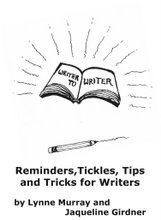
Jaki Girdner and I put together Writer-to-Writer Reminders, Tickles, Tips and Tricks. Between us, we’ve had a total of 22 books published—16 for her, 6 for me. We should know some things worth sharing. The tips take place as a dialog between two writers: Ms. Reminder, who is extraordinarily organized, with tickle files for events planned years in advance, and Ms. Amnesia….well, she has a little problem with authority, outlines and planning ahead. We had a good time writing 52 tips, one a week for a year and an extra one to finish.
With a little help from a graphically sophisticated friend, this was translated into an Adobe PDF, and officially put out as an ebook.
As Hamlet says, "the rest is silence." Silent meditation? Actually last weekend it was silent medication because my back went out the minute the book was all Eeee-ed up, and introduced to Paypal.
Coincidence? I think not.
Of course any novelist is capable of functioning with zero feedback and encouragement. It goes with the territory. Most of the fiction being published even by large presses as such a minimal promotion budget that authors learn quickly to use any publicity idea they can manage to get the word out about their books. Like many authors, I’ve become obsessed with this subject. Not particularly expert, just obsessed.
But how to promote an ebook? Bookstores wouldn't be involved. Hmmm. Repeated internet searches yielded predatory websites that had more in common with “work at home” and multi-level marketing scams than they did with anything remotely applicable to promotion of entertaining material that someone might want to read.
Obviously never telling anyone about the book isn't going to work either.
So, now that my back is better, mentioning Writer-to-Writer Reminders on this blog is the next baby step into the Mountains of E-Madness. You can probably tell I've been re-reading H.P. Lovecraft--but that was this past week--30 years ago I was hitting the library like a locust infestation.
May 4 to May 20, 1977 I read, in whole or in part:
SnowBlind, A Brief Career in the Cocaine Trade, Robert Sabhag
The Fight, Norman Mailer
The Omnivorous Ape, Lyall Watson
The Sound of Two Hands Clapping, Essays by Kenneth Tynan
Sigh, theatrical criticism, Olivier playing all the great classic roles in the 1940's and 50's, I have a weakness for theatrical critical essays, and Tynan was such a superb writer.
Three Tales, Paul Bowles
Note: Esoteric almost to the point of nonexistence
Tiny Tim: An Unauthorized Biography, Harry Stein
Tiny Tim
Intent on Laughter, John Bailey
Couldn’t find much on this, out of print. But when I looked for it, I found and loved, this website.
About Those Roses, Frank D. Gilroy
A Burnt Out Case, Graham Greene
For me the anticipation of reading Greene is always more fun than the actual reading. He just can't seem to make me savor his world-weary depression.
Ya gotta grant him the prize for angst, though.
How the Comedy Writers Create Laughter, Larry Wilde
Turns out this guy is still around, and he invented National Humor Month (April, I missed it, who knew?) I like his good-humored web site.
The Plays of Ferenc Molnar (1929, intro only)
I still have the quote I got from Molnar, slightly paraphrased, on the wall above my writing desk: “Shakespeare was a genius. The rest of us must simply strive to be honest.”
Translation, Stephen Marlowe
Note: very disturbing cover art. Poorly written story
May 4 to May 20, 2007 I read:
The Orchid Thief,Susan Orlean
I also watched the film Adaptation wherein screenwriter suffers so much turning The Orchid Thief into a script, that he takes that struggle as the film's subject matter. Reading the book after watching the film, I could see his problem. The book was essentially a magazine article on intercut with lots of background and information. Interesting but not essentially a story. The movie also had one of my favorite writing teachers, Robert McKee, teaching his seminar on Story. Very cool.
Blood Bound, (Mercy Thompson Series, Book 2): Books: Patricia Briggs
Moving slowly back into the tamer paranormal novels I like so much
At the Mountains of Madness, H.P. Lovecraft
An old favorite, a paperback that must be nearly 40 years old. I’ll talk about obscene vegetation another time.
Jaki Girdner and I put together Writer-to-Writer Reminders, Tickles, Tips and Tricks. Between us, we’ve had a total of 22 books published—16 for her, 6 for me. We should know some things worth sharing. The tips take place as a dialog between two writers: Ms. Reminder, who is extraordinarily organized, with tickle files for events planned years in advance, and Ms. Amnesia….well, she has a little problem with authority, outlines and planning ahead. We had a good time writing 52 tips, one a week for a year and an extra one to finish.
With a little help from a graphically sophisticated friend, this was translated into an Adobe PDF, and officially put out as an ebook.
As Hamlet says, "the rest is silence." Silent meditation? Actually last weekend it was silent medication because my back went out the minute the book was all Eeee-ed up, and introduced to Paypal.
Coincidence? I think not.
Of course any novelist is capable of functioning with zero feedback and encouragement. It goes with the territory. Most of the fiction being published even by large presses as such a minimal promotion budget that authors learn quickly to use any publicity idea they can manage to get the word out about their books. Like many authors, I’ve become obsessed with this subject. Not particularly expert, just obsessed.
But how to promote an ebook? Bookstores wouldn't be involved. Hmmm. Repeated internet searches yielded predatory websites that had more in common with “work at home” and multi-level marketing scams than they did with anything remotely applicable to promotion of entertaining material that someone might want to read.
Obviously never telling anyone about the book isn't going to work either.
So, now that my back is better, mentioning Writer-to-Writer Reminders on this blog is the next baby step into the Mountains of E-Madness. You can probably tell I've been re-reading H.P. Lovecraft--but that was this past week--30 years ago I was hitting the library like a locust infestation.
May 4 to May 20, 1977 I read, in whole or in part:
SnowBlind, A Brief Career in the Cocaine Trade, Robert Sabhag
The Fight, Norman Mailer
The Omnivorous Ape, Lyall Watson
The Sound of Two Hands Clapping, Essays by Kenneth Tynan
Sigh, theatrical criticism, Olivier playing all the great classic roles in the 1940's and 50's, I have a weakness for theatrical critical essays, and Tynan was such a superb writer.
Three Tales, Paul Bowles
Note: Esoteric almost to the point of nonexistence
Tiny Tim: An Unauthorized Biography, Harry Stein
Tiny Tim
Intent on Laughter, John Bailey
Couldn’t find much on this, out of print. But when I looked for it, I found and loved, this website.
About Those Roses, Frank D. Gilroy
A Burnt Out Case, Graham Greene
For me the anticipation of reading Greene is always more fun than the actual reading. He just can't seem to make me savor his world-weary depression.
Ya gotta grant him the prize for angst, though.
How the Comedy Writers Create Laughter, Larry Wilde
Turns out this guy is still around, and he invented National Humor Month (April, I missed it, who knew?) I like his good-humored web site.
The Plays of Ferenc Molnar (1929, intro only)
I still have the quote I got from Molnar, slightly paraphrased, on the wall above my writing desk: “Shakespeare was a genius. The rest of us must simply strive to be honest.”
Translation, Stephen Marlowe
Note: very disturbing cover art. Poorly written story
May 4 to May 20, 2007 I read:
The Orchid Thief,Susan Orlean
I also watched the film Adaptation wherein screenwriter suffers so much turning The Orchid Thief into a script, that he takes that struggle as the film's subject matter. Reading the book after watching the film, I could see his problem. The book was essentially a magazine article on intercut with lots of background and information. Interesting but not essentially a story. The movie also had one of my favorite writing teachers, Robert McKee, teaching his seminar on Story. Very cool.
Blood Bound, (Mercy Thompson Series, Book 2): Books: Patricia Briggs
Moving slowly back into the tamer paranormal novels I like so much
At the Mountains of Madness, H.P. Lovecraft
An old favorite, a paperback that must be nearly 40 years old. I’ll talk about obscene vegetation another time.
Friday, May 04, 2007
Secret teachings, the power of positive denial
I slowly eased reading books that are not by Jane Austen (my comfort reads for the past few months!) with a transitional period listening to 4-hour(!) audio DVD of The Secret, which a friend lent me.
The hook that gets people “into the tent” for this product, whether in video, book, or audio, is the pitch that this is a life-transforming "Secret." Yet the underlying principles, whether called The Laws of Attraction, the Power of Positive Thinking are familiar to even the most casual student of self-help books.
I like positive thinkers and New Age presentation people. As Douglas Adams said of the planet earth, they are “mostly harmless” and occasionally helpful. But the kindest thing I can say of The Secret is that it is partial—as in a fragmentary or limited. In its truncated fashion, it explains how, with single-minded thought, a person can affect his or her environment. There are some useful ideas in The Secret, presented with the maximum of smoke and sizzle and very little insight or responsibility.
I will consider using any mental or physical tool that doesn’t clash with my Buddhist practice. (I won’t channel, don’t ask me.) So I’ve encountered (and enjoyed studying) some of these New Age Usual Suspects. I didn’t like the metaphor of ordering your reality from a catalog. That one was too aggressively shallow for me. Also as a world view, the idea that you create the entire universe with your thoughts strikes me as childish at best and delusional at its worst.
I do like the metaphor of “change the frequency of your thought vibrations, like changing the radio channel.” I can almost hear an echo of an explanation of Buddhism as it was presented to Americans in the 1960s and ‘70’s (and it may have been a direct steal—such metaphors do get around). One of the unlooked for side-effects of a Buddhist practice is learning how to become aware of and move out of negative life conditions (as an exercise that must be repeated by the way, it’s not a one-time thing!)
The latter half of the DVD set made me a bit queasy with its exhortations to “believe” when doubt attacks. That sort of talk always induces deep mistrust in me--and an urge to head for the nearest Exit sign.
I’m not going to get into the “negative thinking caused the Holocaust” thread (my brother hit the nail on head when he said, “So, the Holocaust victims were all thinking negatively and the Nazis were thinking really positively?”) This is not the first time such views have been brought forth, but that doesn't make them less offensive.
For me it’s a sure-fire indicator of a con game when the salesperson plays the weight loss card. The weight loss issue draws con men like an overripe banana draws fruit flies. it's such a gold mine that few can resist. Such a large percentage of Americans are freaked out about their weight that playing on the hopes of a magical solution causes many to instantly reach for their wallets.
As a fat person, listening to their spiel, I was pleased at the suggestion not to dwell on your body’s flaws, that’s always more constructive. But I was wryly amused to hear the suggestion that followers "achieve their perfect weight" ("losing” is one of those banned, negative words)by looking away when fat people appear and instead envisioning their internal perfect body. I guess if I walk down the street and see people bumping into lampposts rather than look at me, “la, la, la, you don’t exiiiiiist…la, la, la, I’m thinking of my own perfect body…” I’ll know that it’s a Secretarian. Or will I?
Actually, invisibility in social situations is one of the side effects of getting old and/or fat. All of which The Secret assures me do not have to happen.
When I first started listening to the DVDs I wondered if there was any correlation at all between actual secret teachings in mystical tradition, and the positive thinking stuff they are invoking as the secret of the ages. A friend who is into the Western alchemical/metaphysical tradition pointed out that the concept of secret teachings can be to protect a student from getting in too deep too soon. My own experience in Buddhism has been that even when a secret teaching is revealed it is usually so simple that an untrained mind can’t see any profound meaning at all there. It can take decades of practice to realize how deep something so simple can be.
I suggested to a friend who was about to listen to the DVDs is “take what you need and leave the rest.”
April 16 to May 3, 1977 I read:
1876, Gore Vidal
English Humour, J.B. Priestly
Note: v. fine, also beautifully illustrated. (didn’t finish though)
Stop the Presses, I Want to Get Off, [MORE Magazine] R. Pollak [Ed]
The Man with the Candy, the Story of the Houston Mass Murders, J. Olsen
Read most of it
The American Tradition, A Gallery of Rogues, John Greenaway
Patchwork Mouse, Joseph Hixson
Darker Than Amber, John D. MacDonald
Gateway, Frederick Pohl
Scoundrel Time, Lillian Hellman
I first encountered Hellman in her preface to some of Dashiell Hammett’s posthumously published work. She was a glamorous figure, not the least because of her life with the magnetic Hammett. Who wouldn’t want to be with Hammett? Many were called and briefly chosen, but Hellman was the one who lasted. The fact that he told her she was the model for Nora, of Nick and Nora in The Thin Man made her even more interesting. Nick and Nora Charles have always been the ideal fun couple for more than one generation. Early in their marriage my parents named their dog Asta in honor of the Charles’ memorable terrier. I’ve read all of Hammett several times, but never have read any of Hellman’s non-memoir work, although I did see the movie The Little Foxes, and was startled by how over-the-top melodramatic it was.
From April 16 to May 3, 2007
Aside from listening to The Secret DVD, in the past few weeks I re-read:
Scoundrel Time, Lillian Hellman.
I remember noting what a thin book it was when I first read it, sitting on a bench at a bus stop in 1977. The edition I read recently has it collected along with Hellman’s other memoirs, An Unfinished Woman and Pentimento. Scoundrel Time only takes up 123 pages—with wide margins.
Hellman
I think nowadays Hellman would be called “high maintenance.” She savors and shares her emotions the way some people share fine cuisine. This is part of her charm, and yet one can’t help but mistrust it.
One of the anecdotes she tells is of an old friend, unsuccessful Progressive candidate for President, Henry Wallace, who presented her with a large bag of manure on the occasion of her selling her farm due to financial disaster after she and Hammett were blacklisted and unable to find work. Hellman mildly complains that this was not a gift she could use in the New York apartment she was moving to, and puts it down to Wallace’s total cluelessness—and she gives several other persuasive examples of this. But something about the gift made me wonder if there weren’t others who might have wished to give her such a gift, but just didn’t have it handy when the occasion presented itself.
The hook that gets people “into the tent” for this product, whether in video, book, or audio, is the pitch that this is a life-transforming "Secret." Yet the underlying principles, whether called The Laws of Attraction, the Power of Positive Thinking are familiar to even the most casual student of self-help books.
I like positive thinkers and New Age presentation people. As Douglas Adams said of the planet earth, they are “mostly harmless” and occasionally helpful. But the kindest thing I can say of The Secret is that it is partial—as in a fragmentary or limited. In its truncated fashion, it explains how, with single-minded thought, a person can affect his or her environment. There are some useful ideas in The Secret, presented with the maximum of smoke and sizzle and very little insight or responsibility.
I will consider using any mental or physical tool that doesn’t clash with my Buddhist practice. (I won’t channel, don’t ask me.) So I’ve encountered (and enjoyed studying) some of these New Age Usual Suspects. I didn’t like the metaphor of ordering your reality from a catalog. That one was too aggressively shallow for me. Also as a world view, the idea that you create the entire universe with your thoughts strikes me as childish at best and delusional at its worst.
I do like the metaphor of “change the frequency of your thought vibrations, like changing the radio channel.” I can almost hear an echo of an explanation of Buddhism as it was presented to Americans in the 1960s and ‘70’s (and it may have been a direct steal—such metaphors do get around). One of the unlooked for side-effects of a Buddhist practice is learning how to become aware of and move out of negative life conditions (as an exercise that must be repeated by the way, it’s not a one-time thing!)
The latter half of the DVD set made me a bit queasy with its exhortations to “believe” when doubt attacks. That sort of talk always induces deep mistrust in me--and an urge to head for the nearest Exit sign.
I’m not going to get into the “negative thinking caused the Holocaust” thread (my brother hit the nail on head when he said, “So, the Holocaust victims were all thinking negatively and the Nazis were thinking really positively?”) This is not the first time such views have been brought forth, but that doesn't make them less offensive.
For me it’s a sure-fire indicator of a con game when the salesperson plays the weight loss card. The weight loss issue draws con men like an overripe banana draws fruit flies. it's such a gold mine that few can resist. Such a large percentage of Americans are freaked out about their weight that playing on the hopes of a magical solution causes many to instantly reach for their wallets.
As a fat person, listening to their spiel, I was pleased at the suggestion not to dwell on your body’s flaws, that’s always more constructive. But I was wryly amused to hear the suggestion that followers "achieve their perfect weight" ("losing” is one of those banned, negative words)by looking away when fat people appear and instead envisioning their internal perfect body. I guess if I walk down the street and see people bumping into lampposts rather than look at me, “la, la, la, you don’t exiiiiiist…la, la, la, I’m thinking of my own perfect body…” I’ll know that it’s a Secretarian. Or will I?
Actually, invisibility in social situations is one of the side effects of getting old and/or fat. All of which The Secret assures me do not have to happen.
When I first started listening to the DVDs I wondered if there was any correlation at all between actual secret teachings in mystical tradition, and the positive thinking stuff they are invoking as the secret of the ages. A friend who is into the Western alchemical/metaphysical tradition pointed out that the concept of secret teachings can be to protect a student from getting in too deep too soon. My own experience in Buddhism has been that even when a secret teaching is revealed it is usually so simple that an untrained mind can’t see any profound meaning at all there. It can take decades of practice to realize how deep something so simple can be.
I suggested to a friend who was about to listen to the DVDs is “take what you need and leave the rest.”
April 16 to May 3, 1977 I read:
1876, Gore Vidal
English Humour, J.B. Priestly
Note: v. fine, also beautifully illustrated. (didn’t finish though)
Stop the Presses, I Want to Get Off, [MORE Magazine] R. Pollak [Ed]
The Man with the Candy, the Story of the Houston Mass Murders, J. Olsen
Read most of it
The American Tradition, A Gallery of Rogues, John Greenaway
Patchwork Mouse, Joseph Hixson
Darker Than Amber, John D. MacDonald
Gateway, Frederick Pohl
Scoundrel Time, Lillian Hellman
I first encountered Hellman in her preface to some of Dashiell Hammett’s posthumously published work. She was a glamorous figure, not the least because of her life with the magnetic Hammett. Who wouldn’t want to be with Hammett? Many were called and briefly chosen, but Hellman was the one who lasted. The fact that he told her she was the model for Nora, of Nick and Nora in The Thin Man made her even more interesting. Nick and Nora Charles have always been the ideal fun couple for more than one generation. Early in their marriage my parents named their dog Asta in honor of the Charles’ memorable terrier. I’ve read all of Hammett several times, but never have read any of Hellman’s non-memoir work, although I did see the movie The Little Foxes, and was startled by how over-the-top melodramatic it was.
From April 16 to May 3, 2007
Aside from listening to The Secret DVD, in the past few weeks I re-read:
Scoundrel Time, Lillian Hellman.
I remember noting what a thin book it was when I first read it, sitting on a bench at a bus stop in 1977. The edition I read recently has it collected along with Hellman’s other memoirs, An Unfinished Woman and Pentimento. Scoundrel Time only takes up 123 pages—with wide margins.
Hellman
I think nowadays Hellman would be called “high maintenance.” She savors and shares her emotions the way some people share fine cuisine. This is part of her charm, and yet one can’t help but mistrust it.
One of the anecdotes she tells is of an old friend, unsuccessful Progressive candidate for President, Henry Wallace, who presented her with a large bag of manure on the occasion of her selling her farm due to financial disaster after she and Hammett were blacklisted and unable to find work. Hellman mildly complains that this was not a gift she could use in the New York apartment she was moving to, and puts it down to Wallace’s total cluelessness—and she gives several other persuasive examples of this. But something about the gift made me wonder if there weren’t others who might have wished to give her such a gift, but just didn’t have it handy when the occasion presented itself.
Saturday, April 14, 2007
A debt to pleasure...of the literary kind
Another almost-month with no books read. Existential anxiety has that effect on me. However, I have been revisiting a manuscript of my own that needs work. That process reminds me why I have always traded financial security for time. (In the interests of full disclosure I should say that every job I've done that offered financial security has been so excruciatingly dull that my mind might have snapped under the strain. So the psychiatrist's bills I have saved by pursuing the muse should be factored into the equation.)
A phrase that keeps coming back to me recently is the title of a book Bruce Taylor set up by the cash register in his Mystery Bookstore in SF, now ably commanded by Diane Kudisch as Bruce has retired. The book Bruce was handselling was John Lanchester’s excellent crime novel, The Debt to Pleasure
Lanchester plucked the quote from John Wilmot, the Earl of Rochester. I'd never heard of Wilmot, which is not surprising, considering how outrageous his work was. I'm not a scholarly student of his time period, and if Henry Miller and D.H. Lawrence couldn't be published during most of the 20th century due to censorship, Wilmot wasn't going to be showing up in any poetry anthologies. He was notorious, even among his fellow Restoration Rakes.
“Hazlitt judged that 'his verses cut and sparkle like diamonds', while 'his contempt for everything that others respect almost amounts to sublimity'.”
Rochester's bio.
Most of his poems seem to include all the commoner Anglo-Saxon four-letter words. His subject matter is either ruttish or scurrilous and the phrase that stuck in my mind from his poem, The Imperfect Enjoyment, is used during a discussion of premature ejaculation—
When, with a thousand kisses wandering o'er
My panting bosom, "Is there then no more?"
She cries. "All this to love and rapture's due
Must we not pay a debt to pleasure too?"
Note, this site is not for the prudish.
The debt Wilmot refers to is the pretty simple, "you pleased me and now I'm incapable of pleasing you, sorry about that, dear." Wilmot died at 33, probably of syphillis--another debt to pleasure paid.
But for me the phrase seems to refer to the cost of doing what you want to do...or need to do.
The book I began to write in the spring of '77 was a good learning experience, but essentially, unreadably bad. Even the title is too embarrassing to quote. I am hoping the friends upon whom I inflicted this book have mercifully forgotten it.
The manuscript I’m now editing is my 10th book. Book 11 is with my agent. Book 12 is in progress, put it aside to do this edit. Although it hasn’t found a publisher yet (and I am finding things to improve in the ms.) Book 10 after lo these many re-writes/re-reads still makes me laugh. It ain’t Shakespeare, but I knew that going in. There are no cringe-worthy moments.
(If you're mathematically inclined, I'll explain that 6 of my books have been published, and 3 sit in the closet, including the abysmal first novel.)
So that’s what I did with my last 30 years. I’m not naĂŻve enough to think that this entitles me to anything in a material sense. But it’s what I wanted to do with my life.
Damn that existential anxiety! I think it’s insinuating a whiny note into this blog. So enough about now, looking back 30 years--
March 11 to April 15, 1977 I read.
Orbit 18, Damon Knight
Victorian Murderesses, Mary S. Hartman
Only got three-quarter way through it.
Carrie, Stephen King
This was one of those books I remember reading, where I was when I read it (on a cockroach-menaced sofa bed, in the dim light of afternoon, at a time when absorbing storytelling was welcome). Whatever one may think of Stephen King after the crushing juggernaut of his success has swept its way through the reading world, I think back to reading Carrie and thinking—wow, that’s good.
A Plague of Demons, John Creasy, as Gordon Ash
The Art of Seeing, Aldous Huxley
Had to skip last few pages.
So You Have Glaucoma, Viers
Note—I didn’t. But the Lions’ free glaucoma testing van student doctors thought I might, and that netted me an anxious few weeks—during which I read this book. Also a free appointment for more extensive testing that indicated I just had weirdly shaped eye nerves…I was the only person under 50 in the waiting room. Also the experience of having my father reassure me that if I did have glaucoma, he would personally drive me to Mexico to get marijuana if I also needed that—my father’s version of worrying, although he was by nature more of a warrior than a worrier.
The Medically Based No-Nonsense Beauty Book, Deborah Chase
Oy. I was 27, living in LA and far from immune to the beauty obsession. I do give myself points for a little common sense with this one.
Magic, William Goodman
Born on the Fourth of July, Ron Kovic
My memory was that I had reviewed this book several months earlier for the Buddhist newspaper. Maybe I was re-reading, as it was quite a powerful book
1876, Gore Vidal
From March 11 to April 14, 2007
Reading and re-writing one of my own manuscripts.
A phrase that keeps coming back to me recently is the title of a book Bruce Taylor set up by the cash register in his Mystery Bookstore in SF, now ably commanded by Diane Kudisch as Bruce has retired. The book Bruce was handselling was John Lanchester’s excellent crime novel, The Debt to Pleasure
Lanchester plucked the quote from John Wilmot, the Earl of Rochester. I'd never heard of Wilmot, which is not surprising, considering how outrageous his work was. I'm not a scholarly student of his time period, and if Henry Miller and D.H. Lawrence couldn't be published during most of the 20th century due to censorship, Wilmot wasn't going to be showing up in any poetry anthologies. He was notorious, even among his fellow Restoration Rakes.
“Hazlitt judged that 'his verses cut and sparkle like diamonds', while 'his contempt for everything that others respect almost amounts to sublimity'.”
Rochester's bio.
Most of his poems seem to include all the commoner Anglo-Saxon four-letter words. His subject matter is either ruttish or scurrilous and the phrase that stuck in my mind from his poem, The Imperfect Enjoyment, is used during a discussion of premature ejaculation—
When, with a thousand kisses wandering o'er
My panting bosom, "Is there then no more?"
She cries. "All this to love and rapture's due
Must we not pay a debt to pleasure too?"
Note, this site is not for the prudish.
The debt Wilmot refers to is the pretty simple, "you pleased me and now I'm incapable of pleasing you, sorry about that, dear." Wilmot died at 33, probably of syphillis--another debt to pleasure paid.
But for me the phrase seems to refer to the cost of doing what you want to do...or need to do.
The book I began to write in the spring of '77 was a good learning experience, but essentially, unreadably bad. Even the title is too embarrassing to quote. I am hoping the friends upon whom I inflicted this book have mercifully forgotten it.
The manuscript I’m now editing is my 10th book. Book 11 is with my agent. Book 12 is in progress, put it aside to do this edit. Although it hasn’t found a publisher yet (and I am finding things to improve in the ms.) Book 10 after lo these many re-writes/re-reads still makes me laugh. It ain’t Shakespeare, but I knew that going in. There are no cringe-worthy moments.
(If you're mathematically inclined, I'll explain that 6 of my books have been published, and 3 sit in the closet, including the abysmal first novel.)
So that’s what I did with my last 30 years. I’m not naĂŻve enough to think that this entitles me to anything in a material sense. But it’s what I wanted to do with my life.
Damn that existential anxiety! I think it’s insinuating a whiny note into this blog. So enough about now, looking back 30 years--
March 11 to April 15, 1977 I read.
Orbit 18, Damon Knight
Victorian Murderesses, Mary S. Hartman
Only got three-quarter way through it.
Carrie, Stephen King
This was one of those books I remember reading, where I was when I read it (on a cockroach-menaced sofa bed, in the dim light of afternoon, at a time when absorbing storytelling was welcome). Whatever one may think of Stephen King after the crushing juggernaut of his success has swept its way through the reading world, I think back to reading Carrie and thinking—wow, that’s good.
A Plague of Demons, John Creasy, as Gordon Ash
The Art of Seeing, Aldous Huxley
Had to skip last few pages.
So You Have Glaucoma, Viers
Note—I didn’t. But the Lions’ free glaucoma testing van student doctors thought I might, and that netted me an anxious few weeks—during which I read this book. Also a free appointment for more extensive testing that indicated I just had weirdly shaped eye nerves…I was the only person under 50 in the waiting room. Also the experience of having my father reassure me that if I did have glaucoma, he would personally drive me to Mexico to get marijuana if I also needed that—my father’s version of worrying, although he was by nature more of a warrior than a worrier.
The Medically Based No-Nonsense Beauty Book, Deborah Chase
Oy. I was 27, living in LA and far from immune to the beauty obsession. I do give myself points for a little common sense with this one.
Magic, William Goodman
Born on the Fourth of July, Ron Kovic
My memory was that I had reviewed this book several months earlier for the Buddhist newspaper. Maybe I was re-reading, as it was quite a powerful book
1876, Gore Vidal
From March 11 to April 14, 2007
Reading and re-writing one of my own manuscripts.
Sunday, March 11, 2007
Jane Austen, hell, heaven, and perfume
I won’t go into exhaustive detail about why, but I’ve had enough of a disruptive month that I’ve been communing with Jane Austen (and a little with Virginia Woolf) these past few weeks. I don’t do images much—but I’ll share with you an image that paradoxically helped me stay sane.
Money and the lack thereof are an issue Virginia Woolf dissects so brilliantly in A Room of One’s Own.
Jane Austen also considers women’s issues around money in all her works, as she said in an 1816 letter: “Single women have a dreadful propensity for being poor. Which is one very strong argument in favor of matrimony.”
While coping with my own employment drama the past few weeks, I found it useful to think of some of the things Virginia Woolf did to support herself before she received the famous liberating inheritance that she wrote about in the aforementioned book.
"I earned a few pounds by addressing envelopes, reading to old ladies, making artificial flowers.” A Room of One’s Own by Virginia Woolf
I must report that for the old and broken among us, the employment opportunities are somewhat, although not vastly, improved since she wrote those words in 1928. I seem to have found a momentary harbor, so I am now calm enough to write this blog.
But to get back some of my strategies for staying sane while losing sleep over survival issues. I read (and re-read) only three books. (Contrasting with 14 books I picked up in 1977 in the same space of time, with an even shakier personal life, but coasting on youthful vitality!) I also visited ther DVDs of Pride and Prejudice and Persuasion, um, more than once.
Why were these so uniquely comforting? Of course, there is sex—or should we say the heartfelt portrayal of youthful passion.
The Republic of Pemberley website provides the graphic I referred to in the first paragraph. It's the last item of their FAQ:
What is "The Look"?
Get ready.
Here.
I was surprised to find that it was the same image that caught my attention. Why should I be surprised? It’s the Bluestocking version of the money shot. But it’s a bit more than that.
The actor and filmmaker’s recreation of the intoxication of young love is like a distillation of the scent of flowers. Spring has gone, but an artfully created perfume stirs a chord that resurrects spring flowers in the heart and mind.
Jane Austen’s books go one better. She re-creates on the page, not only the pleasure of intimacy achieved, but also the satisfaction of integrity rewarded.
That’s the paradox of art. Jane Austen didn’t have that ideal partnership in her life. She never married and died at age 38. I can only speak for myself in saying that at 58 I would contemplate with dismay the vast drain of time and energy that a fulfilling partnership would entail. Of course, a happy ending is just a snapshot in a long story.
Young love pierces our souls (as Frederick says of Anne's words in Persuasion) because it depends on the exquisite sensitivity of innocence, inexperience, ignorance, call it what you will. That naiveté has a season and it does not come again, Botox notwithstanding.
Robert Frost put it well:
Love at the lips was touch
As sweet as I could bear;
And once that seemed too much;
I lived on air
That crossed me from sweet things,
The flow of- was it musk
From hidden grapevine springs
Down hill at dusk?
. . . .
Now no joy but lacks salt
That is not dashed with pain
And weariness and fault;
I crave the stain
Of tears, the aftermark
Of almost too much love,
The sweet of bitter bark
And burning clove.
To Earthward by Robert Frost From “New Hampshire” 1923.
Well, Frost did seem to have a little S&M thing going there that’s only marginally relevant to what I’m mainly talking about, but never mind. He’s right about how complex things become, and how it catches our breath to remember how simple they once seemed—and perhaps were.
From February 8 to March 11, 1977 I read:
Thirty years ago I had just moved twice in the space of a few months (down to Los Angeles from San Francisco. Then out of the Culver City garage apartment I first landed in, to a more serene studio apartment in West LA where the cockroaches came as single scouts--not in battalions), and was sailing on a questionable sea of temp work. Yet I managed to read or attempt 14 books.
Midnight Baby, Dory Previn
The Psycho Sqaud, William W. Crain
The Romeo Error: A matter of Life and Death, Lyall Watson
Note: couldn’t finish in time – had to return to library. Will try again. (note—so far haven’t, but then it HAS only been 30 years)
The 9th Annual Best SF: 75, Harry Harrison & Brian W. Aldiss, Ed.
The Art of Alfred Hitchcock, Donal Spoto
Note: AH is a Leo- Aug 13! Very fascinating book. I also guessed correctly by the author’s use of the adjective “tenebrous” that he was French.
Tricks and Treats: an anthology of Mystery Stories by the Mystery Writers of America,
Joe Gores and Bill Pronzini, Ed.
Something’s There, Dan Greenberg
The Voices of the Guns, Vin McLellen and Paul Avery
The Aliens, Ed. R. Silverberg
Tetrosomy Two, Oscar Rossiter
The Choirboys, Joseph Wambaugh
The Documents in the Case, Dorothy L. Sayers and Robert Eustace
Journey, Robert and Suzanne Massie
Very painful to read, medical students’ disease-I vaguely remember that this book was about a couple coping with spinal cord injury, but I could be wrong.
The Blue Knight, Joseph Wambaugh
From February 8 to March 11, 2007 I read:
Pride and Prejudice, Jane Austen
With some attention to the excellent introduction Penguin Classics edition by Tony Tanner that among other things, speaks to the idea of “the dream of Pemberley” that so many women have mentally inhabited since Austen built the place.
A Room of One’s Own, Virginia Woolf
Persuasion, Jane Austen
Money and the lack thereof are an issue Virginia Woolf dissects so brilliantly in A Room of One’s Own.
Jane Austen also considers women’s issues around money in all her works, as she said in an 1816 letter: “Single women have a dreadful propensity for being poor. Which is one very strong argument in favor of matrimony.”
While coping with my own employment drama the past few weeks, I found it useful to think of some of the things Virginia Woolf did to support herself before she received the famous liberating inheritance that she wrote about in the aforementioned book.
"I earned a few pounds by addressing envelopes, reading to old ladies, making artificial flowers.” A Room of One’s Own by Virginia Woolf
I must report that for the old and broken among us, the employment opportunities are somewhat, although not vastly, improved since she wrote those words in 1928. I seem to have found a momentary harbor, so I am now calm enough to write this blog.
But to get back some of my strategies for staying sane while losing sleep over survival issues. I read (and re-read) only three books. (Contrasting with 14 books I picked up in 1977 in the same space of time, with an even shakier personal life, but coasting on youthful vitality!) I also visited ther DVDs of Pride and Prejudice and Persuasion, um, more than once.
Why were these so uniquely comforting? Of course, there is sex—or should we say the heartfelt portrayal of youthful passion.
The Republic of Pemberley website provides the graphic I referred to in the first paragraph. It's the last item of their FAQ:
What is "The Look"?
Get ready.
Here.
I was surprised to find that it was the same image that caught my attention. Why should I be surprised? It’s the Bluestocking version of the money shot. But it’s a bit more than that.
The actor and filmmaker’s recreation of the intoxication of young love is like a distillation of the scent of flowers. Spring has gone, but an artfully created perfume stirs a chord that resurrects spring flowers in the heart and mind.
Jane Austen’s books go one better. She re-creates on the page, not only the pleasure of intimacy achieved, but also the satisfaction of integrity rewarded.
That’s the paradox of art. Jane Austen didn’t have that ideal partnership in her life. She never married and died at age 38. I can only speak for myself in saying that at 58 I would contemplate with dismay the vast drain of time and energy that a fulfilling partnership would entail. Of course, a happy ending is just a snapshot in a long story.
Young love pierces our souls (as Frederick says of Anne's words in Persuasion) because it depends on the exquisite sensitivity of innocence, inexperience, ignorance, call it what you will. That naiveté has a season and it does not come again, Botox notwithstanding.
Robert Frost put it well:
Love at the lips was touch
As sweet as I could bear;
And once that seemed too much;
I lived on air
That crossed me from sweet things,
The flow of- was it musk
From hidden grapevine springs
Down hill at dusk?
. . . .
Now no joy but lacks salt
That is not dashed with pain
And weariness and fault;
I crave the stain
Of tears, the aftermark
Of almost too much love,
The sweet of bitter bark
And burning clove.
To Earthward by Robert Frost From “New Hampshire” 1923.
Well, Frost did seem to have a little S&M thing going there that’s only marginally relevant to what I’m mainly talking about, but never mind. He’s right about how complex things become, and how it catches our breath to remember how simple they once seemed—and perhaps were.
From February 8 to March 11, 1977 I read:
Thirty years ago I had just moved twice in the space of a few months (down to Los Angeles from San Francisco. Then out of the Culver City garage apartment I first landed in, to a more serene studio apartment in West LA where the cockroaches came as single scouts--not in battalions), and was sailing on a questionable sea of temp work. Yet I managed to read or attempt 14 books.
Midnight Baby, Dory Previn
The Psycho Sqaud, William W. Crain
The Romeo Error: A matter of Life and Death, Lyall Watson
Note: couldn’t finish in time – had to return to library. Will try again. (note—so far haven’t, but then it HAS only been 30 years)
The 9th Annual Best SF: 75, Harry Harrison & Brian W. Aldiss, Ed.
The Art of Alfred Hitchcock, Donal Spoto
Note: AH is a Leo- Aug 13! Very fascinating book. I also guessed correctly by the author’s use of the adjective “tenebrous” that he was French.
Tricks and Treats: an anthology of Mystery Stories by the Mystery Writers of America,
Joe Gores and Bill Pronzini, Ed.
Something’s There, Dan Greenberg
The Voices of the Guns, Vin McLellen and Paul Avery
The Aliens, Ed. R. Silverberg
Tetrosomy Two, Oscar Rossiter
The Choirboys, Joseph Wambaugh
The Documents in the Case, Dorothy L. Sayers and Robert Eustace
Journey, Robert and Suzanne Massie
Very painful to read, medical students’ disease-I vaguely remember that this book was about a couple coping with spinal cord injury, but I could be wrong.
The Blue Knight, Joseph Wambaugh
From February 8 to March 11, 2007 I read:
Pride and Prejudice, Jane Austen
With some attention to the excellent introduction Penguin Classics edition by Tony Tanner that among other things, speaks to the idea of “the dream of Pemberley” that so many women have mentally inhabited since Austen built the place.
A Room of One’s Own, Virginia Woolf
Persuasion, Jane Austen
Wednesday, February 07, 2007
Old wine, new bottles
The internet came to my rescue once again last week, when I couldn’t locate my paperback copy of Jane Eyre during a week when I was indulging in the stunning BBC dramatization of that work. The BBC site is very cool by the way, Grace Poole's diary was surprisingly touching! But to return to my rescue by the internet--a few days later, while delving into the 1996 (6-hour!) DVD of Pride and Prejudice, I couldn't find that paperback either!
Most classic texts are now available online, so I didn’t have to wait for the delivery of the new copies (or haul out my very heavy Complete Novels of Jane Austen hardcover) to check out how the dramatizations might have changed the sacred texts that have provided emotional healing for me (as for so many others) at various times in my life when it was most needed.
But even the best dramatizations--often the best!--take certain liberties with the text. For example, Jane Eyre’s parting with Rochester after his secret was revealed. I was able to confirm what I kind of remembered from my reading--that no bed was involved in their parting scene in the book (though there was a sofa, it was more used for sobbing than for touching). The breathless chemistry was appropriate to the novel though.
A friend lent me the A&E Pride and Prejudice dramatization, and in return I lent her the 1986 BBC Northanger Abbey, confidently assuring her that Colin Firth was practically a chameleon to be able to play Mr. Darcy in P&P and also play Henry Tilney in Northanger Abbey, and look so different. Almost like a different person.
Astute readers and BBC aficionados will be way ahead of me here. Colin Firth was so amazingly different-looking in his characterization of Henry Tilney in Northanger Abbey because the part was, in fact, played by Peter Firth—another actor entirely. Also excellent--with his own gift for revealing thoughts as well as emotions on screen--just not the same person.
I guess there’s no point in having so many Gracie Allen moments if you can’t laugh at yourself in the process.
At least I discovered that Henry Tilney has his own fan club, who refer to him as "Da Man"--who knew?
My Jane Austen obsession flares often enough that one friend gave me a
Jane Austen Action Figure for a Christmas gift.
I visited The Republic of Pemberley
for the online texts of Pride and Prejudice, and found that Austen summarized, rather than exactly quoting, a great deal of Mr. Darcy’s original, ardent proposal to Elizabeth Bennet, and the A&E dramatization did quite well putting the summary into dialog.
The Republic of Pemberley, by the way, has the subject of each chapter in the link(and a lot of other links to topics in the books).
John Barrymore was of the opinion that stopping to read footnotes while enjoying great works of literature is like answering the doorbell on your honeymoon. I tend to agree. But once you’ve had the enjoyment of a read or two or twelve of some of these books, an appropriate footnote can help deepen the experience. Marital aids, perhaps?
January 21 to February 7, 1977
I can’t help but notice my restless library roving in 1977 brought me home 13 books (some I only partly read, versus the two books, I own but ended up reading online during the same days of 2007).
The Mote in God’s Eye, Niven & Pournell
I enjoyed this book a great deal and have re-read it more than once.
A 30-year-old review goes into the “Crazy Eddie” concept at some length
The Jacqueline Susann Story, Jeffrey Ventura
My note: “effeminate prose” whatever that means.
We’re Going to Make You a Star, Sally Quinn
My note: “a little celebrity watching in the haute monde of the journalism world. Having been fascinated by the Washington Post’s role in investigating Watergate, I read quite a few behind-the-scenes books. My final note was: “The ‘society’ orientation makes me bristle a bit.”Sally Quinn on wikipedia
Lonely in America, Suzanne Gordon,
My note: didn’t finish
Memoirs, Tennessee Williams
My note: Such frankness that one is forced to applaud, yet not particularly painful to read
The Life of Raymond Chandler, Frank McShane
My note: Read some of it. Very sad, dreary
I think that one was really painful to read, although I totally admire his prose, his life was less exuberant and more agonizing than Williams' life.
The Deep, Peter Benchley
My note –Skimpy & trivial but readable. All the villains are black, all the heroes white, coincidence no doubt
Headache: Understanding—Alleviation, James W. Lance
My note: Not helpful
On the Edge, James Mills
My note: Skimpy
Bubbles: a Self-Portrait, Beverly Sills
Future Corruption, Ed. Roger Elwood
My note: very amateurish. Didn’t finish
Combat SF, Gordon R. Dickson
My note: Didn’t even half finish
Singin’ and Swingin’ and Gettin’ Merry Like Christmas, Maya Angelou
No note on this, but I read every Maya Angelou book I could find, poetry and prose.
January 21 to February 7, 2007
I probably enjoyed re-reading these two books as much as I enjoyed reading the 13 from 1977.
Jane Eyre, Charlotte Bronte
Pride and Prejudice, Jane Austen
Most classic texts are now available online, so I didn’t have to wait for the delivery of the new copies (or haul out my very heavy Complete Novels of Jane Austen hardcover) to check out how the dramatizations might have changed the sacred texts that have provided emotional healing for me (as for so many others) at various times in my life when it was most needed.
But even the best dramatizations--often the best!--take certain liberties with the text. For example, Jane Eyre’s parting with Rochester after his secret was revealed. I was able to confirm what I kind of remembered from my reading--that no bed was involved in their parting scene in the book (though there was a sofa, it was more used for sobbing than for touching). The breathless chemistry was appropriate to the novel though.
A friend lent me the A&E Pride and Prejudice dramatization, and in return I lent her the 1986 BBC Northanger Abbey, confidently assuring her that Colin Firth was practically a chameleon to be able to play Mr. Darcy in P&P and also play Henry Tilney in Northanger Abbey, and look so different. Almost like a different person.
Astute readers and BBC aficionados will be way ahead of me here. Colin Firth was so amazingly different-looking in his characterization of Henry Tilney in Northanger Abbey because the part was, in fact, played by Peter Firth—another actor entirely. Also excellent--with his own gift for revealing thoughts as well as emotions on screen--just not the same person.
I guess there’s no point in having so many Gracie Allen moments if you can’t laugh at yourself in the process.
At least I discovered that Henry Tilney has his own fan club, who refer to him as "Da Man"--who knew?
My Jane Austen obsession flares often enough that one friend gave me a
Jane Austen Action Figure for a Christmas gift.
I visited The Republic of Pemberley
for the online texts of Pride and Prejudice, and found that Austen summarized, rather than exactly quoting, a great deal of Mr. Darcy’s original, ardent proposal to Elizabeth Bennet, and the A&E dramatization did quite well putting the summary into dialog.
The Republic of Pemberley, by the way, has the subject of each chapter in the link(and a lot of other links to topics in the books).
John Barrymore was of the opinion that stopping to read footnotes while enjoying great works of literature is like answering the doorbell on your honeymoon. I tend to agree. But once you’ve had the enjoyment of a read or two or twelve of some of these books, an appropriate footnote can help deepen the experience. Marital aids, perhaps?
January 21 to February 7, 1977
I can’t help but notice my restless library roving in 1977 brought me home 13 books (some I only partly read, versus the two books, I own but ended up reading online during the same days of 2007).
The Mote in God’s Eye, Niven & Pournell
I enjoyed this book a great deal and have re-read it more than once.
A 30-year-old review goes into the “Crazy Eddie” concept at some length
The Jacqueline Susann Story, Jeffrey Ventura
My note: “effeminate prose” whatever that means.
We’re Going to Make You a Star, Sally Quinn
My note: “a little celebrity watching in the haute monde of the journalism world. Having been fascinated by the Washington Post’s role in investigating Watergate, I read quite a few behind-the-scenes books. My final note was: “The ‘society’ orientation makes me bristle a bit.”Sally Quinn on wikipedia
Lonely in America, Suzanne Gordon,
My note: didn’t finish
Memoirs, Tennessee Williams
My note: Such frankness that one is forced to applaud, yet not particularly painful to read
The Life of Raymond Chandler, Frank McShane
My note: Read some of it. Very sad, dreary
I think that one was really painful to read, although I totally admire his prose, his life was less exuberant and more agonizing than Williams' life.
The Deep, Peter Benchley
My note –Skimpy & trivial but readable. All the villains are black, all the heroes white, coincidence no doubt
Headache: Understanding—Alleviation, James W. Lance
My note: Not helpful
On the Edge, James Mills
My note: Skimpy
Bubbles: a Self-Portrait, Beverly Sills
Future Corruption, Ed. Roger Elwood
My note: very amateurish. Didn’t finish
Combat SF, Gordon R. Dickson
My note: Didn’t even half finish
Singin’ and Swingin’ and Gettin’ Merry Like Christmas, Maya Angelou
No note on this, but I read every Maya Angelou book I could find, poetry and prose.
January 21 to February 7, 2007
I probably enjoyed re-reading these two books as much as I enjoyed reading the 13 from 1977.
Jane Eyre, Charlotte Bronte
Pride and Prejudice, Jane Austen
Saturday, January 20, 2007
Hermits, sociable writers and the quest for myth
For me 1977 was the year that my writing began to take the form of a novel. Writing is such a personal and private thing for me that it's taken me years to understand that some people write well in groups (as it was for Anne Beatts below). That kind of writing still seems to me to be more akin to music than words, but I could see how it would work well for comedy as a performing art, which has a particularly strong rhythmical component.
January 3 to 20, 2007
Titters : The first collection of humor by women, Deanne Stillman and Anne P. Beatts
It’s been awhile since I read this. I didn't quite get at the time just how difficult it was for women to be taken seriously in humor...does that make sense? I mean that there were a lot more male humorists being published than women.
Beatts has famously written about the early Saturday Night Live as not welcoming women:
"The only entrée to that boys club was basically by fucking somebody in the club," Anne Beatts tells Shales and Miller. "Which wasn't the reason you were fucking them necessarily. I mean, you didn't go "Oh, I want to get into this, I think I'll have to have sex with this person.' It was just that if you were drawn to funny people who were doing interesting things, then the only real way to get to do those things yourself was to make that connection."
Here's that quote
This book has been called dated, but I don't have the copy I bought, so I can't check it. I still remember selling my copy at a garage sale. It was the first thing to go—snapped up immediately at a premium price. Maybe the cover…?
Here's what Beatts is doing now.
Intermission, Anne Baxter
This was a fascinating book, one I’ve read more than once—the story of Baxter’s leaving Hollywood for love and a life on a remote cattle station in Australia
Anne Baxter
Homage to Daniel Shays, Collected essays, Gore Vidal
This page gives an idea of the scope of Vidal's life and accomplishment, and ideas that shine in his essays.
Vidal
Early del Rey, Lester del Rey
Here's an interesting 1968 review of 2001 by del Rey
Review
Wampeters, Foma & Grandfaloons, Kurt Vonnegut, Jr.
My comment was “bravo!”
Vonnegut Quotes
January 3 to 20, 2007
Lately I've been retreating even further from the sociable model. The Middle Earth book below gave me some insights into why. I think it's a cyclical thing for me. I remember (like so many people) reading Tolkien as a refuge at 14, and again at 24. After an intermission of decades, I'm back seeking fantasy wherever I can find it.
Crazy in Alabama, Mark Childress
This was unexpectedly fun and funny (I understand there was a movie, and reading the book I can imagine that). The narration alternates between the parallel stories of 12-year-old orphan Peejoe Bullis in a small Alabama town in 1965, and his Aunt Lucille, who has parked her six children with her mother and is bound for Hollywood accompanied only by her murdered husband’s head in Tupperware container.
The Publisher’s Weekly review suggests that the author manages to inject: “magic in his mixture of humor and pathos, boyish candor and time-earned understanding. The narrative has a unique gentleness that tempers even the most extreme horrific or comic events without dismissing or oversimplifying them. Terrible crimes go unpunished, and good people face tragedy--not always nobly--but this remains a tale of laughter and great hope, one not easily forgotten.”
That’s a pretty accurate assessment of an extraordinary narrative accomplishment.
Thunderbird Falls, CE Murphy
The second book featuring Joanne Walker, Seattle beat cop and apprentice shaman. Not as fast-moving as the first book Urban Shaman, but still worth the read.
Meditations on Middle Earth, Karen Haber (Ed)
This book has some great contributors like Terry Pratchett, Poul Andersen, and Robin Hobb
The essays in this book gave me some insight into my own reading tastes lately—
Lisa Goldstein’s essay put it:
“Why do people read and reread these books? Why are they so powerful? What do we get from them that we can’t get anywhere else? ...
“My guess is that it’s because we need myth. Not just because myths are entertaining stories, or because some of them come attached with a moral. We need them, the way we need vitamins or sunlight.
...
We need them because they are magnificent stories, of course, tales that have been told as long as people have existed. But we also need them because they are stories about the hero who journeys into a dark place and comes out transformed, and that is a story we allknow intimately, a story each of us experiences in his or her life. Those dragons are our dragons, those magical helpers are our helpers. And sometimes the dragons are inside us, a part of us, and this is the most terrifying struggle of all.”
January 3 to 20, 2007
Titters : The first collection of humor by women, Deanne Stillman and Anne P. Beatts
It’s been awhile since I read this. I didn't quite get at the time just how difficult it was for women to be taken seriously in humor...does that make sense? I mean that there were a lot more male humorists being published than women.
Beatts has famously written about the early Saturday Night Live as not welcoming women:
"The only entrée to that boys club was basically by fucking somebody in the club," Anne Beatts tells Shales and Miller. "Which wasn't the reason you were fucking them necessarily. I mean, you didn't go "Oh, I want to get into this, I think I'll have to have sex with this person.' It was just that if you were drawn to funny people who were doing interesting things, then the only real way to get to do those things yourself was to make that connection."
Here's that quote
This book has been called dated, but I don't have the copy I bought, so I can't check it. I still remember selling my copy at a garage sale. It was the first thing to go—snapped up immediately at a premium price. Maybe the cover…?
Here's what Beatts is doing now.
Intermission, Anne Baxter
This was a fascinating book, one I’ve read more than once—the story of Baxter’s leaving Hollywood for love and a life on a remote cattle station in Australia
Anne Baxter
Homage to Daniel Shays, Collected essays, Gore Vidal
This page gives an idea of the scope of Vidal's life and accomplishment, and ideas that shine in his essays.
Vidal
Early del Rey, Lester del Rey
Here's an interesting 1968 review of 2001 by del Rey
Review
Wampeters, Foma & Grandfaloons, Kurt Vonnegut, Jr.
My comment was “bravo!”
Vonnegut Quotes
January 3 to 20, 2007
Lately I've been retreating even further from the sociable model. The Middle Earth book below gave me some insights into why. I think it's a cyclical thing for me. I remember (like so many people) reading Tolkien as a refuge at 14, and again at 24. After an intermission of decades, I'm back seeking fantasy wherever I can find it.
Crazy in Alabama, Mark Childress
This was unexpectedly fun and funny (I understand there was a movie, and reading the book I can imagine that). The narration alternates between the parallel stories of 12-year-old orphan Peejoe Bullis in a small Alabama town in 1965, and his Aunt Lucille, who has parked her six children with her mother and is bound for Hollywood accompanied only by her murdered husband’s head in Tupperware container.
The Publisher’s Weekly review suggests that the author manages to inject: “magic in his mixture of humor and pathos, boyish candor and time-earned understanding. The narrative has a unique gentleness that tempers even the most extreme horrific or comic events without dismissing or oversimplifying them. Terrible crimes go unpunished, and good people face tragedy--not always nobly--but this remains a tale of laughter and great hope, one not easily forgotten.”
That’s a pretty accurate assessment of an extraordinary narrative accomplishment.
Thunderbird Falls, CE Murphy
The second book featuring Joanne Walker, Seattle beat cop and apprentice shaman. Not as fast-moving as the first book Urban Shaman, but still worth the read.
Meditations on Middle Earth, Karen Haber (Ed)
This book has some great contributors like Terry Pratchett, Poul Andersen, and Robin Hobb
The essays in this book gave me some insight into my own reading tastes lately—
Lisa Goldstein’s essay put it:
“Why do people read and reread these books? Why are they so powerful? What do we get from them that we can’t get anywhere else? ...
“My guess is that it’s because we need myth. Not just because myths are entertaining stories, or because some of them come attached with a moral. We need them, the way we need vitamins or sunlight.
...
We need them because they are magnificent stories, of course, tales that have been told as long as people have existed. But we also need them because they are stories about the hero who journeys into a dark place and comes out transformed, and that is a story we allknow intimately, a story each of us experiences in his or her life. Those dragons are our dragons, those magical helpers are our helpers. And sometimes the dragons are inside us, a part of us, and this is the most terrifying struggle of all.”
Tuesday, January 02, 2007
Resolute words
Happy New Year to All!
People really do ask what your resolutions are. I don't much like the term "resolutions." I have goals, but they are intensely personal and I think of them all through the year, although a little more on New Year's Day. One thing that brings extra pain to this process of sharing resolutions for the next year is when I run into people who are throwing themselves into the not-so-harmless idea of solving all their problems by losing weight. (Few people call it a diet any more, but most of the resolutions involve restricted eating, and those who get to hear about them often have to suffer through hearing sample menus. Then there's the unavoidable postscript about how unhappy they are with their bodies and how the new "eating plan" will solve all that.)
Lara Frater at Fat Chicks Rule talks about how difficult it is not to resist the fantasy world when everyone around you is buying in big time to the madness and deprivation, and pressuring you to do likewise.
Lara quotes Marilyn Wann’s response last summer to a woman drowning in an ocean of Weight Watchers fanatics swimming in the high tide of "shrink-yourself-to-fit-the-bathing suit" season:
I totally appreciate the constant, pervasive pressure to buy the hate. This is the second-biggest time of year for people to go crazy hoping to be thin. There's January 1 and then there's bathing-suit season. So it's not about you. Fat hatred is just at high tide.
Diets are hate rituals. Any practice that involves a goal of weight loss is a hate ritual. I don't care whether it's "sensible" or extreme. I don't care whether Weight Watchers advises exactly the same food that I choose for myself because it's tasty and nutritious on any given day. They are selling hate. I won't give them a dollar or a minute of attention. As an ethical person, I could never advise another human being to undertake such dangerous, harmful, deceitful scams.
Marilyn's article is in the Summer 2006 NAAFA newsletter.
We now return you to our regularly scheduled reading “retro” book action.
December 24, 1976 to January 2, 1977
The Final Days, Carl Bernstein and Bob Woodward
There's even been a book written about how Woodward and Bernstein's spectacular early success overshadowed later life... Woodward and Bernstein book page.
Ah, well, as they say in the Midwest, thank heaven for small favors. Being a late-blooming, non-spectacular achiever has at least rescued this writer from THAT trauma.
The Once and Future King, T.H. White
This was the second or third time I read this book, which I discovered when I was 14. It was one of those books where you remember the first time you picked it up, where you were and what it looked like. A family friend stored some books and games with us and said I could play with any of the games--which I did, a little--and read any of the books. Wow. This one was a much-read hardcover, but I remember being careful with the dust cover. It’s still a book I make sure to have a copy of at all times.
The Wind Chill Factor, Thomas Gifford
Oddly enough all I remember about this book was that at some point the hero was driving through a blizzard in a Lincoln Continental.
The Middle Mist, Mary Renault
This was one of her modern novels. The Charioteer was my favorite of those, but it is her novels set in ancient Greece—The Last of the Wine, etc.--that I remember with most fondness.
The Samurai, George MacBeth
No recollection of this book
December 24, 2006 to January 2, 2007
The Bromeliad Trilogy: Truckers, Diggers, and Wings, Terry Pratchett
This is not a Discworld book, but Pratchett is always entertaining and these three books about 4-inch Nomes looking for a home is charming, suspenseful and oddly heartening. Pratchett’s theme in this book (as in most of his works) is how learning and growing, and how it gets done in ways you never could plan. A good book to start the new year.
Big Fat Lies, Glenn Gaesser, Ph.D.
This book has been reissued (updated by the author) by Gurze Books, which does a tremendous service in keeping available books on body positive issues, eating disorders and size prejudice. As a baby boomer, I was nine when I ran into my first doctor waving a diet sheet and an amphetamine prescription the late 1950s. The one thing that struck me about this book was how every aspect of the anti-fat obsession affected my life as the national hysteria took root.
Big Fat Lies traces the life insurance industry’s meaningless charts (fervently embraced by the American Medical Association in 1951) and the drive to turn weight into the single measure of health, in spite of overwhelming scientific evidence to the contrary.
People really do ask what your resolutions are. I don't much like the term "resolutions." I have goals, but they are intensely personal and I think of them all through the year, although a little more on New Year's Day. One thing that brings extra pain to this process of sharing resolutions for the next year is when I run into people who are throwing themselves into the not-so-harmless idea of solving all their problems by losing weight. (Few people call it a diet any more, but most of the resolutions involve restricted eating, and those who get to hear about them often have to suffer through hearing sample menus. Then there's the unavoidable postscript about how unhappy they are with their bodies and how the new "eating plan" will solve all that.)
Lara Frater at Fat Chicks Rule talks about how difficult it is not to resist the fantasy world when everyone around you is buying in big time to the madness and deprivation, and pressuring you to do likewise.
Lara quotes Marilyn Wann’s response last summer to a woman drowning in an ocean of Weight Watchers fanatics swimming in the high tide of "shrink-yourself-to-fit-the-bathing suit" season:
I totally appreciate the constant, pervasive pressure to buy the hate. This is the second-biggest time of year for people to go crazy hoping to be thin. There's January 1 and then there's bathing-suit season. So it's not about you. Fat hatred is just at high tide.
Diets are hate rituals. Any practice that involves a goal of weight loss is a hate ritual. I don't care whether it's "sensible" or extreme. I don't care whether Weight Watchers advises exactly the same food that I choose for myself because it's tasty and nutritious on any given day. They are selling hate. I won't give them a dollar or a minute of attention. As an ethical person, I could never advise another human being to undertake such dangerous, harmful, deceitful scams.
Marilyn's article is in the Summer 2006 NAAFA newsletter.
We now return you to our regularly scheduled reading “retro” book action.
December 24, 1976 to January 2, 1977
The Final Days, Carl Bernstein and Bob Woodward
There's even been a book written about how Woodward and Bernstein's spectacular early success overshadowed later life... Woodward and Bernstein book page.
Ah, well, as they say in the Midwest, thank heaven for small favors. Being a late-blooming, non-spectacular achiever has at least rescued this writer from THAT trauma.
The Once and Future King, T.H. White
This was the second or third time I read this book, which I discovered when I was 14. It was one of those books where you remember the first time you picked it up, where you were and what it looked like. A family friend stored some books and games with us and said I could play with any of the games--which I did, a little--and read any of the books. Wow. This one was a much-read hardcover, but I remember being careful with the dust cover. It’s still a book I make sure to have a copy of at all times.
The Wind Chill Factor, Thomas Gifford
Oddly enough all I remember about this book was that at some point the hero was driving through a blizzard in a Lincoln Continental.
The Middle Mist, Mary Renault
This was one of her modern novels. The Charioteer was my favorite of those, but it is her novels set in ancient Greece—The Last of the Wine, etc.--that I remember with most fondness.
The Samurai, George MacBeth
No recollection of this book
December 24, 2006 to January 2, 2007
The Bromeliad Trilogy: Truckers, Diggers, and Wings, Terry Pratchett
This is not a Discworld book, but Pratchett is always entertaining and these three books about 4-inch Nomes looking for a home is charming, suspenseful and oddly heartening. Pratchett’s theme in this book (as in most of his works) is how learning and growing, and how it gets done in ways you never could plan. A good book to start the new year.
Big Fat Lies, Glenn Gaesser, Ph.D.
This book has been reissued (updated by the author) by Gurze Books, which does a tremendous service in keeping available books on body positive issues, eating disorders and size prejudice. As a baby boomer, I was nine when I ran into my first doctor waving a diet sheet and an amphetamine prescription the late 1950s. The one thing that struck me about this book was how every aspect of the anti-fat obsession affected my life as the national hysteria took root.
Big Fat Lies traces the life insurance industry’s meaningless charts (fervently embraced by the American Medical Association in 1951) and the drive to turn weight into the single measure of health, in spite of overwhelming scientific evidence to the contrary.
Saturday, December 23, 2006
Backstage at strips…and with strippers…
I hope everyone is enjoying the holiday--whatever yours might be. I like the Buddhist idea of starting fresh with the new year--paying bills by year-end, pre-spring housecleaning, etc. A Buddhist friend pointed out that you could (and we probably should) start out fresh every day of the year, but being humans we need to be reminded by having a day set out for the purpose. It certainly serves the purpose of allowing me to postpone the whole new start thing till next week when the actual new year arrives.
Nostalgia and holidays seem to go together, but I try to resist it by means of escaping into fiction, and more recently movies on DVDs. Thirty years ago I couldn't have imagined watching all the BBC dramatizations of Jane Austen's novels (advertised as 17 hours of Jane Austen!); now modern technology has made it easier to escape into the the past.
My holiday reading 30 years ago and this year provide some common themes, or maybe just strange bedfellows. "Backstage at the comic strips" in 1976 and backstage at strip clubs in 2006. Then there's the Alan Alda autobiography that includes fond memories of watching from the wings as his father performed in burlesque, singing while showgirls paraded onstage.
I do find it a little amusing that the one "literary" work on this list back in 1976 is the one I never managed to finish reading.
From December 11 to 23, 1976, I read:
Heroes, Joe McGinnis
I've read some of his other books, notably: The Selling of the President 1968 and Blind Faith, but I don't always connect them as being written by the same person…for what that's worth as an insight.Here's an article on him.
Backstage at the Strips, Mort Walker
One of the major motivations to learn to read for me was to be able to read the comic strips, including Mort Walker's Beetle Bailey, in the Sunday newspaper.
How It Was, Mary Hemingway
This 1961 Time Article
is actually a pretty comprehensive appreciation of Hemingway.
Turquoise Lament, John D. MacDonald
The Sentinel, Jeffrey Konvitz
Konvitz co-authored the screenplay as well (too scary for me, though the book wasn't quite so scary).
Gulliver's Travels, Jonathan Swift
My note is "Only got as far as page 67…" Oh, well, maybe one day...
From December 11 to 23, 2006, I read:
Strip City: A Stripper's Farewell Journey Across America, Lily Burana
Backstage at a whole different kind of strip, Lily Burana is taking a final strip odyssey across the US in order to come to terms with a five-year stretch stripping in her teens and twenties before getting married. Burana now lives in Wyoming and writes fiction as well as nonfiction.
Never Have Your Dog Stuffed: And Other Things I've Learned, Alan Alda
Interesting autobiography and insights from Alan Alda, who seems as genial and witty on paper as he is on film and video.
website
Nostalgia and holidays seem to go together, but I try to resist it by means of escaping into fiction, and more recently movies on DVDs. Thirty years ago I couldn't have imagined watching all the BBC dramatizations of Jane Austen's novels (advertised as 17 hours of Jane Austen!); now modern technology has made it easier to escape into the the past.
My holiday reading 30 years ago and this year provide some common themes, or maybe just strange bedfellows. "Backstage at the comic strips" in 1976 and backstage at strip clubs in 2006. Then there's the Alan Alda autobiography that includes fond memories of watching from the wings as his father performed in burlesque, singing while showgirls paraded onstage.
I do find it a little amusing that the one "literary" work on this list back in 1976 is the one I never managed to finish reading.
From December 11 to 23, 1976, I read:
Heroes, Joe McGinnis
I've read some of his other books, notably: The Selling of the President 1968 and Blind Faith, but I don't always connect them as being written by the same person…for what that's worth as an insight.Here's an article on him.
Backstage at the Strips, Mort Walker
One of the major motivations to learn to read for me was to be able to read the comic strips, including Mort Walker's Beetle Bailey, in the Sunday newspaper.
How It Was, Mary Hemingway
This 1961 Time Article
is actually a pretty comprehensive appreciation of Hemingway.
Turquoise Lament, John D. MacDonald
The Sentinel, Jeffrey Konvitz
Konvitz co-authored the screenplay as well (too scary for me, though the book wasn't quite so scary).
Gulliver's Travels, Jonathan Swift
My note is "Only got as far as page 67…" Oh, well, maybe one day...
From December 11 to 23, 2006, I read:
Strip City: A Stripper's Farewell Journey Across America, Lily Burana
Backstage at a whole different kind of strip, Lily Burana is taking a final strip odyssey across the US in order to come to terms with a five-year stretch stripping in her teens and twenties before getting married. Burana now lives in Wyoming and writes fiction as well as nonfiction.
Never Have Your Dog Stuffed: And Other Things I've Learned, Alan Alda
Interesting autobiography and insights from Alan Alda, who seems as genial and witty on paper as he is on film and video.
website
Sunday, December 10, 2006
Structural integrity in characters & character integrity in life
November 25 to December 10, 1976 I read:
Caution, Inflammable, Thomas N. Scortia
Short stories.
Thomas N. Scortia
Josh, My Up and Down, In and Out Life, Joshua Logan
What I now remember about this book was Logan's thoughtful discussion of his struggles with manic depression and how it both helped and hurt his art.
an appreciation
However, my note to myself on reading the book was more structural:
Interesting point: Maxwell Anderson's definition of enduring drama--a hero must learn his own fatal flaw and grows in the process.
And--
Logan's def. of farce as desperation of characters over a misunderstanding or problem that is tragic to them, ridiculous to the audience. The characters' mounting desperation captures the attention and makes the farce "move rapidly."
November 25 to December 10, 2006 I read:
Don't Weight: Eat Healthy and Get Moving Now!, Kelly Bliss
I wouldn't have bought this book if I hadn't read Kelly Bliss's website. I was curious to hear the rest of her story. But I'm glad I did. In 1980, long before Jennifer Portnick's discrimination case against Jazzercise, detailed in an interview here, Kelly Bliss was encountering blatant prejudice against instructors, however fit and talented. At 5 feet tall and 127 pounds, she was frankly told that she could not be hired, despite her excellent qualifications, because she did not fit their company image of an extremely thin instructor. The suggestions the interviewer made were identical to the advice Bliss had received years earlier that had sent her into an eating disorder.
She responded first of all by tell the interviewer just what kind of damage she was doing by handing out such advice(go Kelly!), then she went out to start her own classes, offering low impact exercise at a time when it was rarely offered. She made such a success of this business that she was about to start her own studio in 1991, when a traffic accident left her with a seizure disorder and she had to begin again. Just coming back from that kind of injury is impressive, but she gained the wisdom from the experience to reach out to others in new ways. Bliss's accomplishments in mentoring and inspiring others are very healing just to read about. Few people offer such a contagiously positive attitude. Her creative problem solving approaches to fitness for people of all sizes and levels of ability totally charmed me.
Touch the Dark, Karen Chance
This book raised a question for me--at what point do I put down a book that has a fat joke or jokes. Sometimes, as in the case of several of J. K. Rowling's Harry Potter books, I will read the whole book despite long, painful scenes of blatant fat bigotry, simply because the author is an irresistible storyteller. In this case, when the evil master vampire is described as "a soccer ball with legs" I realized that the author was trying to whip up the reader's negative emotions by describing the villain as disgustingly fat. Mission accomplished. Negative emotions whipped up.
I was only on p. 43. Maybe there were other fat jokes, or just the usual horny paranormal critters with flat stomachs. The author did bring out disgust in me, and hadn't hooked me hard enough with her storytelling to keep me reading. So I decided I'd hit a good stopping place and put the book down with no interest in picking it up again.
Anybody Out There?: A Novel, Marian Keyes
I have read most of Marian Keyes books with great pleasure and this was no exception. Part of her skill here is to keep suspense high simply by slowly revealing why and how the heroine sustained her serious physical injuries and what is behind her emotional pain, and then, once that is revealed unfolding how she copes with it.
Dead Man Rising, A Dante Valentine Novel, Lilith Saintcrow
In this second in the series, heroine and Necromance, Dante, doesn't actually go visit hell and accept an assignment from the Prince of Darkness as she did in Working for the Devil, but the plot is equally dramatic. I enjoyed it.
A detailed review.
Caution, Inflammable, Thomas N. Scortia
Short stories.
Thomas N. Scortia
Josh, My Up and Down, In and Out Life, Joshua Logan
What I now remember about this book was Logan's thoughtful discussion of his struggles with manic depression and how it both helped and hurt his art.
an appreciation
However, my note to myself on reading the book was more structural:
Interesting point: Maxwell Anderson's definition of enduring drama--a hero must learn his own fatal flaw and grows in the process.
And--
Logan's def. of farce as desperation of characters over a misunderstanding or problem that is tragic to them, ridiculous to the audience. The characters' mounting desperation captures the attention and makes the farce "move rapidly."
November 25 to December 10, 2006 I read:
Don't Weight: Eat Healthy and Get Moving Now!, Kelly Bliss
I wouldn't have bought this book if I hadn't read Kelly Bliss's website. I was curious to hear the rest of her story. But I'm glad I did. In 1980, long before Jennifer Portnick's discrimination case against Jazzercise, detailed in an interview here, Kelly Bliss was encountering blatant prejudice against instructors, however fit and talented. At 5 feet tall and 127 pounds, she was frankly told that she could not be hired, despite her excellent qualifications, because she did not fit their company image of an extremely thin instructor. The suggestions the interviewer made were identical to the advice Bliss had received years earlier that had sent her into an eating disorder.
She responded first of all by tell the interviewer just what kind of damage she was doing by handing out such advice(go Kelly!), then she went out to start her own classes, offering low impact exercise at a time when it was rarely offered. She made such a success of this business that she was about to start her own studio in 1991, when a traffic accident left her with a seizure disorder and she had to begin again. Just coming back from that kind of injury is impressive, but she gained the wisdom from the experience to reach out to others in new ways. Bliss's accomplishments in mentoring and inspiring others are very healing just to read about. Few people offer such a contagiously positive attitude. Her creative problem solving approaches to fitness for people of all sizes and levels of ability totally charmed me.
Touch the Dark, Karen Chance
This book raised a question for me--at what point do I put down a book that has a fat joke or jokes. Sometimes, as in the case of several of J. K. Rowling's Harry Potter books, I will read the whole book despite long, painful scenes of blatant fat bigotry, simply because the author is an irresistible storyteller. In this case, when the evil master vampire is described as "a soccer ball with legs" I realized that the author was trying to whip up the reader's negative emotions by describing the villain as disgustingly fat. Mission accomplished. Negative emotions whipped up.
I was only on p. 43. Maybe there were other fat jokes, or just the usual horny paranormal critters with flat stomachs. The author did bring out disgust in me, and hadn't hooked me hard enough with her storytelling to keep me reading. So I decided I'd hit a good stopping place and put the book down with no interest in picking it up again.
Anybody Out There?: A Novel, Marian Keyes
I have read most of Marian Keyes books with great pleasure and this was no exception. Part of her skill here is to keep suspense high simply by slowly revealing why and how the heroine sustained her serious physical injuries and what is behind her emotional pain, and then, once that is revealed unfolding how she copes with it.
Dead Man Rising, A Dante Valentine Novel, Lilith Saintcrow
In this second in the series, heroine and Necromance, Dante, doesn't actually go visit hell and accept an assignment from the Prince of Darkness as she did in Working for the Devil, but the plot is equally dramatic. I enjoyed it.
A detailed review.
Friday, November 24, 2006
Triskaidekaphilia
Because both of our parents were from the Midwest, my brother and I heard a lot of G-rated swear words when growing up. One of my favorites my father used was "Triskaidekaphobia" which means fear of the number 13. The wikipedia page on this was fun, because it introduced me to the word friggatriskaidekaphobia, which sounds like something Sylvester The Cat might mutter when really perturbed.
Evidently there is at least one person who loves the number. I'm neutral on the actual number 13, but I really loved the book I read this past week The Thirteenth Tale (see below).
November 12 to 24, 1976 I read:
Bring on the Empty Horses, David Niven
I recall this as a charming and amusing book.
one Niven site.
Change Lobsters and Dance, Lili Palmer
I couldn't find much about Lili Palmer online until I looked for Rex Harrison and Lili Palmer. Being married to Harrison seems to have captured more public attention than her acting, which is generally held to be excellent, though she never became a star of the same magnitude. If this link works, here's a lovely picture of her.
Palmer tells the story that Harrison (then known as "Sexy Rexy" for his philandering ways) asked for a divorce so as to marry Kay Kendall, who was dying--the idea being that he would remarry Palmer afterward. That story sounds like the plot of an old-style "weepy" movie, and it's a little hard to believe. They divorced, Harrison married Kendall, who did die a few years later. Harrison and Palmer did not get back to together. Did anyone really think that would happen? Maybe so. People say and do equally as weird things around relationships and give equally as bizarre explanations every day of the week. In this case all three parties were actors, who dealt spent a great deal of their lives creating illusions. Perhaps they exercised the famous "suspension of disbelief."
Those Who Can, R. S. Wilson, Ed.
No memory of this book.
November 12 to 24, 2006 I read:
Speaking of believing things, sifting truth out from smoke and mirrors, that's a major theme in the book that I liked so much....
The Thirteenth Tale, Diane Setterfield
This book captured very well the hypnotic power of stories--the quote on the back gives its flavor:
My gripe is not with lovers of the truth but with truth herself. What succor, what consolation is there in truth, compared to a story? What good is truth, at midnight, in the dark, when the wind is roaring like a bear in the chimney? What you need are the plump comforts of a story. The soothing, rocking safety of a lie. Vida Winter.
in The Thirteenth Tale
I think it’s something closer kin to dreams rather than lies that stories tell. But part of the art of story telling is in the difference between those two words. "Lies" is a word with a stinging hook in it, while "dreams" is a sweet and sappy word, without enough of a barb in it to snare you in to hear the tale. The quest for the truth among thickets of seductive stories is the theme of this book. The hidden secrets of a reclusive novelist are gradually revealed in the story she needs to tell, but can hardly bring herself to utter. The story needs to be drawn out of her by the narrator, a young woman who has her own ghosts to exorcise in the process. It doesn't get better than this book.
Gil's All Fright Diner, A. Lee Martinez
This book has the dubious distinction of being the first one I've ever posted a negative review about on amazon.com. I got very angry when a book that looked like silly fantasy fun suddenly started dripping authorial venom on one of its characters--a fat woman. The first 14 pages introduced the heroes, Duke and Earl, a grubby werewolf and vampire--seedy vagabonds who wander into Gil's All Night Diner. At that point the author throws in several sneering paragraphs of contemptuous description of the fat woman who owns of the diner.
This woman treats the down-on-their-luck guys very decently, offering them work, food and a place to stay. Then on p, 47 (also known as where I stopped reading), the diner owner tries, in a hesitant way, to seduce the seedy werewolf "hero" who turns away. The author then provides a detailed interior monologue--four pages worth!--of the hero's revulsion at being offered such an unappetizing body, culminating in the werewolf's self-loathing for being the kind of male (one can hardly say "man") who only attracts such a "fat/ugly" women. Let me just say, as I did on Amazon and have elsewhere, that I think telling fat jokes is simply another manifestation of the same prejudice that was reinforced when in-group solidarity was affirmed by telling jokes targeting racial minorities, women, gays and Jews. The assumption was that the targets of these jokes would never be in the audience to hear them. The purpose of the joke was to unite "us" against "them." When it comes to fat jokes in a book, I am the "them" being targeted, and it makes me sick to pay money to be insulted.
I won't comment on the fate of this particular copy of the book, except to say that it won't be spitting venom at any other fat readers--paper can be recycled.
Working for the Devil, Lilith Saintcrow
As if to offset the above disappointment, this author was definitely a happy discovery for me. Dante Valentine, her tough-minded, psychically gifted heroine, raises the dead for a living. This owes a debt to Laurell K. Hamilton, Kim Harrison, etc. It's set in a gritty, Blade-Runner-with-Psychics-Unchained world. A world that has suffered an apocalyptic meltdown of religion and many of its institutions in the face of events that proved undeniable truth of the existence of supernatural entities. The first few scenes take the heroine literally to hell to accept a job to assassinate a demon for the Devil--the alternative being her own death and quite possible the end of human life. Definitely a high stakes game, and a well-told tale.
Saintcrow's cool web site
Evidently there is at least one person who loves the number. I'm neutral on the actual number 13, but I really loved the book I read this past week The Thirteenth Tale (see below).
November 12 to 24, 1976 I read:
Bring on the Empty Horses, David Niven
I recall this as a charming and amusing book.
one Niven site.
Change Lobsters and Dance, Lili Palmer
I couldn't find much about Lili Palmer online until I looked for Rex Harrison and Lili Palmer. Being married to Harrison seems to have captured more public attention than her acting, which is generally held to be excellent, though she never became a star of the same magnitude. If this link works, here's a lovely picture of her.
Palmer tells the story that Harrison (then known as "Sexy Rexy" for his philandering ways) asked for a divorce so as to marry Kay Kendall, who was dying--the idea being that he would remarry Palmer afterward. That story sounds like the plot of an old-style "weepy" movie, and it's a little hard to believe. They divorced, Harrison married Kendall, who did die a few years later. Harrison and Palmer did not get back to together. Did anyone really think that would happen? Maybe so. People say and do equally as weird things around relationships and give equally as bizarre explanations every day of the week. In this case all three parties were actors, who dealt spent a great deal of their lives creating illusions. Perhaps they exercised the famous "suspension of disbelief."
Those Who Can, R. S. Wilson, Ed.
No memory of this book.
November 12 to 24, 2006 I read:
Speaking of believing things, sifting truth out from smoke and mirrors, that's a major theme in the book that I liked so much....
The Thirteenth Tale, Diane Setterfield
This book captured very well the hypnotic power of stories--the quote on the back gives its flavor:
My gripe is not with lovers of the truth but with truth herself. What succor, what consolation is there in truth, compared to a story? What good is truth, at midnight, in the dark, when the wind is roaring like a bear in the chimney? What you need are the plump comforts of a story. The soothing, rocking safety of a lie. Vida Winter.
in The Thirteenth Tale
I think it’s something closer kin to dreams rather than lies that stories tell. But part of the art of story telling is in the difference between those two words. "Lies" is a word with a stinging hook in it, while "dreams" is a sweet and sappy word, without enough of a barb in it to snare you in to hear the tale. The quest for the truth among thickets of seductive stories is the theme of this book. The hidden secrets of a reclusive novelist are gradually revealed in the story she needs to tell, but can hardly bring herself to utter. The story needs to be drawn out of her by the narrator, a young woman who has her own ghosts to exorcise in the process. It doesn't get better than this book.
Gil's All Fright Diner, A. Lee Martinez
This book has the dubious distinction of being the first one I've ever posted a negative review about on amazon.com. I got very angry when a book that looked like silly fantasy fun suddenly started dripping authorial venom on one of its characters--a fat woman. The first 14 pages introduced the heroes, Duke and Earl, a grubby werewolf and vampire--seedy vagabonds who wander into Gil's All Night Diner. At that point the author throws in several sneering paragraphs of contemptuous description of the fat woman who owns of the diner.
This woman treats the down-on-their-luck guys very decently, offering them work, food and a place to stay. Then on p, 47 (also known as where I stopped reading), the diner owner tries, in a hesitant way, to seduce the seedy werewolf "hero" who turns away. The author then provides a detailed interior monologue--four pages worth!--of the hero's revulsion at being offered such an unappetizing body, culminating in the werewolf's self-loathing for being the kind of male (one can hardly say "man") who only attracts such a "fat/ugly" women. Let me just say, as I did on Amazon and have elsewhere, that I think telling fat jokes is simply another manifestation of the same prejudice that was reinforced when in-group solidarity was affirmed by telling jokes targeting racial minorities, women, gays and Jews. The assumption was that the targets of these jokes would never be in the audience to hear them. The purpose of the joke was to unite "us" against "them." When it comes to fat jokes in a book, I am the "them" being targeted, and it makes me sick to pay money to be insulted.
I won't comment on the fate of this particular copy of the book, except to say that it won't be spitting venom at any other fat readers--paper can be recycled.
Working for the Devil, Lilith Saintcrow
As if to offset the above disappointment, this author was definitely a happy discovery for me. Dante Valentine, her tough-minded, psychically gifted heroine, raises the dead for a living. This owes a debt to Laurell K. Hamilton, Kim Harrison, etc. It's set in a gritty, Blade-Runner-with-Psychics-Unchained world. A world that has suffered an apocalyptic meltdown of religion and many of its institutions in the face of events that proved undeniable truth of the existence of supernatural entities. The first few scenes take the heroine literally to hell to accept a job to assassinate a demon for the Devil--the alternative being her own death and quite possible the end of human life. Definitely a high stakes game, and a well-told tale.
Saintcrow's cool web site
Subscribe to:
Posts (Atom)